Delhi’s electricity transition will increasingly depend on expanding distributed renewable energy, battery energy storage, energy efficiency and demand-side flexibility as the capital’s electricity demand continues to rise, according to a new study by the Institute for Energy Economics and Financial Analysis (IEEFA) and Ember.
The study, titled ‘Delhi’s electricity transition challenges and opportunities: A SCOPE study’, assesses the capital’s power sector through its Strengths, Complexities, Opportunities, Policies and Enablers. It highlights Delhi’s limited land availability, constrained scope for large-scale power generation and rising electricity demand from cooling, commercial activity and transport electrification as key factors shaping its clean energy transition.
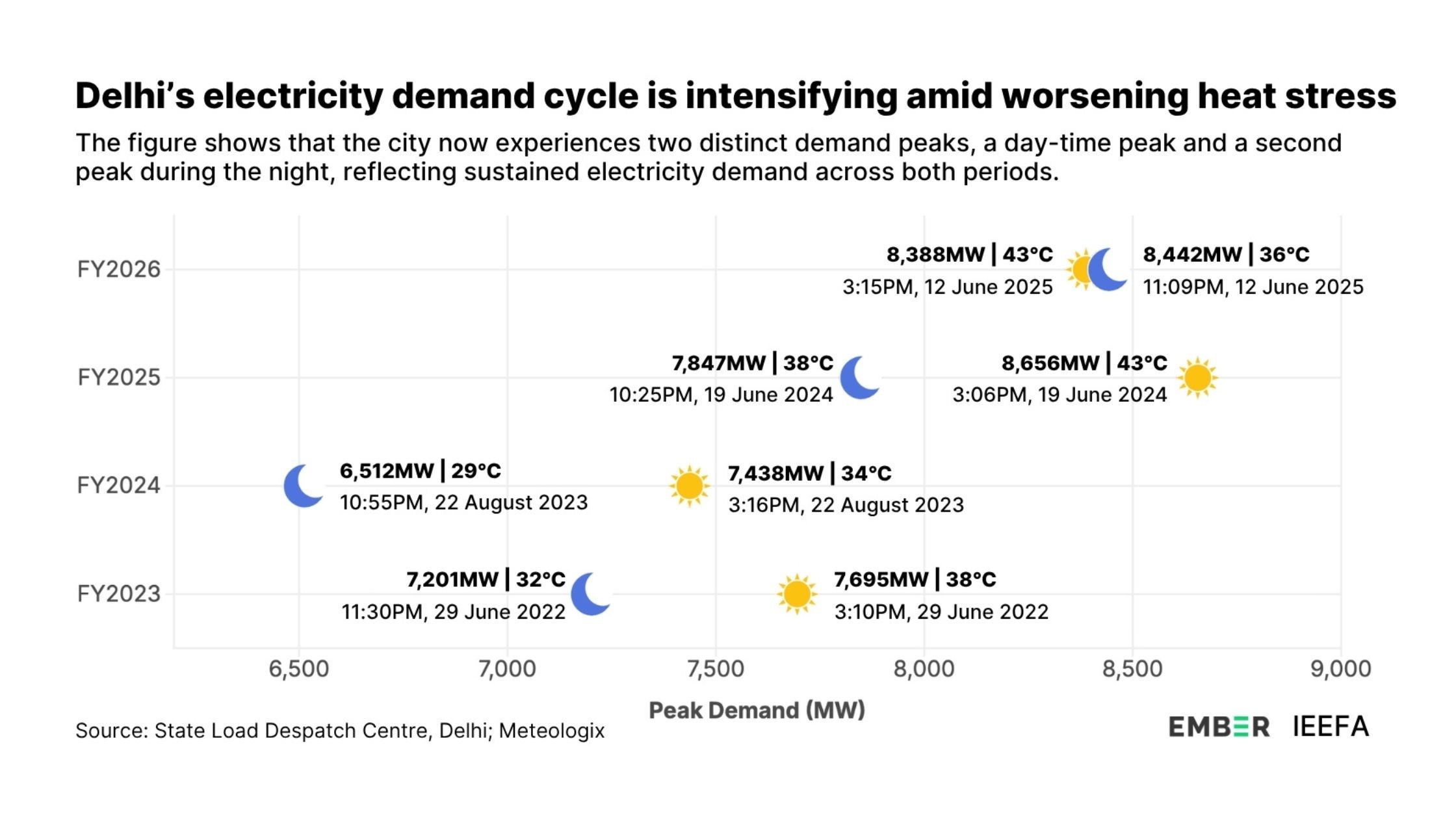
Delhi has successfully managed record peak electricity demand in recent years, but increasing night-time demand peaks could require greater deployment of battery energy storage, smarter electricity pricing and demand-side flexibility. These measures could help maintain grid reliability while reducing the city’s dependence on fossil fuel-based electricity generation.
Unlike many Indian states, Delhi generates only a small share of the electricity it consumes and relies substantially on power allocated from central generating stations and electricity purchases from neighbouring states. As of June 2026, the capital had approximately 7,544 MW of allocated generation capacity, with the study identifying limited land availability as one of the structural constraints behind its reliance on external power procurement.
Delhi’s energy requirement reached 38,482 million units (MU) in FY2026, accounting for approximately 2.2% of India’s total energy requirement. Domestic consumers represented more than half of the city’s electricity consumption, making residential demand a key factor in planning the future power system.
The study identifies distributed renewable energy, particularly rooftop solar, as a major opportunity for reducing emissions. Delhi’s installed distributed solar capacity reached 446 MW by June 2026, supported by policy measures, consumer awareness and financial incentives. The study recommends streamlining approval processes, expanding net-metering provisions and maintaining consumer incentives to accelerate rooftop solar deployment.
Delhi’s clean energy policy framework also includes Green Energy Open Access regulations, a pilot for peer-to-peer rooftop solar electricity trading, and a new electric vehicle policy proposing higher electrification targets, expanded charging infrastructure and measures to strengthen the EV ecosystem.
The study also highlights the need to accelerate battery energy storage system (BESS) deployment, building energy efficiency, smart meter installation, solar-hour-aligned time-of-day tariffs, participation in green electricity market segments and peer-to-peer electricity trading.
Tanya Rana, Energy Analyst, South Asia, IEEFA, and lead author of the study, said Delhi would require a different electricity transition pathway from most Indian states because of its limited potential for utility-scale renewable energy development within its geographical boundaries. She said the city’s transition would instead depend on clean power procurement, rooftop solar and storage, energy efficiency, demand-side flexibility and greater use of power markets.
Ruchita Shah, Energy Analyst, Asia, Ember, and co-author of the study, said Delhi’s distribution sector performance, power procurement planning and distributed renewable energy development provide a foundation for the next phase of its electricity transition.
Saloni Sachdeva Michael, Lead Energy Specialist, South Asia, IEEFA, said opportunities for strengthening Delhi’s transition readiness include faster deployment of battery storage, improved building energy efficiency, wider smart-meter adoption, solar-aligned ToD tariffs, greater participation in green electricity markets and further development of peer-to-peer electricity trading.
Subscribe to get the latest posts sent to your email.