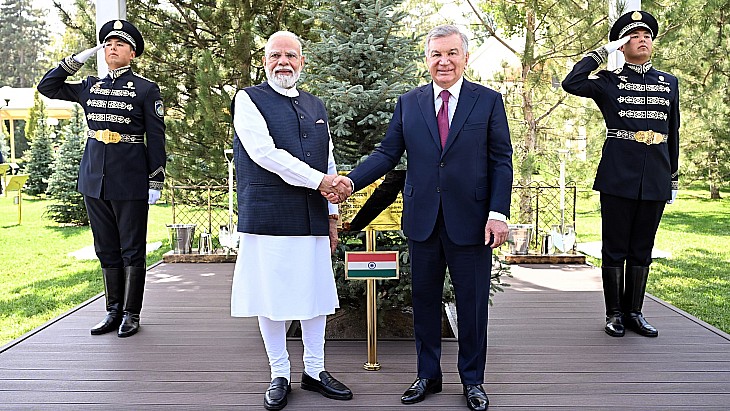
Prime Minister Narendra Modi and President of Uzbekistan Shavkat Mirziyoyev “held wide-ranging and substantive discussions … on the entire gamut of the bilateral strategic partnership”, India’s Ministry of External Affairs said following a state visit by the Indian Prime Minister to Tashkent. The Prime Minister “appreciated the progress made in the long-term arrangement for supply of Uranium from Uzbekistan to India and reaffirmed the importance of strengthening cooperation in critical minerals”, the Ministry added.
Bilateral trade between India and Uzbekistan topped USD1 billion for the first time last year, the leaders noted, and announced their aim to raise trade turnover to USD5 billion by 2030.
The leaders agreed to explore cooperation in areas including geology, mining, nuclear energy, industrial cooperation, and critical & strategic minerals, including projects for the processing of mineral resources, production of value-added products and recycling initiatives, according to a joint statement issued after Modi’s visit. “They also expressed interest in encouraging Indian companies to participate in the development of prospective mineral deposits in Uzbekistan and Uzbek enterprises for joint collaboration in India,” the statement noted, as well as expressing “interest in extended cooperation in peaceful uses of nuclear energy”.
Siby George, Secretary (West) in the Ministry of External Affairs, later told the Hindustan Times: “Positive discussions have happened on long-term arrangement of supply of uranium to India. We are closing in on the signing of an agreement very shortly.”
India currently has about 7,900 MW of nuclear generating capacity from 24 operable nuclear power plants, and is planning a large expansion with ambitions for nuclear energy capacity to reach 100 GW by 2047. The country relies heavily on imported uranium to fuel those reactors: imports presently originate from Kazakhstan, Russia, Uzbekistan and Canada, with an Uzbek long-term contract valid up to 2026.
Recent months have seen the signature of an agreement facilitating the export of uranium from Australia to India, as well as a long-term agreement with Canada’s Cameco to supply uranium ore concentrate to India’s Department of Atomic Energy, for use in the country’s fleet of nuclear reactors.
In August, a parliamentary committee stressed the need for India also to accelerate the expansion of domestic uranium mining projects in a report covering the progress of India’s planned nuclear energy expansion.
Uzbekistan’s estimated uranium output in 2024 was 4,000 tU, according to information from World Nuclear Association, making it the fifth largest uranium producer in the world behind Kazakhstan, Canada, Namibia and Australia.