SGE (formerly Synthos Green Energy) in July submitted an application under the UK’s Advanced Nuclear Framework for reactors which could provide 4.2 GW of capacity, equivalent to 11% of current UK power demand.
Poland’s SGE – whose deployment team includes Samsung C&T, Laing O’Rourke, Aecon Group and Google Cloud – says it will privately finance the deployment of the fleet of GE Vernova Hitachi’s BWRX-300 small modular reactors (SMRs) across three sites in the UK.
The plan is for the initial site to host six of the 300 MW SMRs, with four each at two subsequent sites. The locations of the proposed sites have not yet been disclosed, pending final negotiations.
Rafał Kasprów, CEO of SGE, told World Nuclear News, “I think the UK market has amazing opportunities for SMR developers, and especially us with a fleet approach”.
From the financial point of view he says “we are bringing this investment to the UK … with the disruptive model of not asking government to cover everything on the development and construction phase. We are asking the UK government for Contract for Differences for a fleet of reactors. So it is only when electrons are delivered to the grid that we can benefit from the Contract for Difference model”.
The Contract for Difference (CfD) would work by a future price being agreed for electricity generated by the SMRs – if the price of electricity is higher, the developer will pay the extra back, and if the price of electricity is below the agreed level, the difference is provided to the developer. In the energy sector, a CfD acts as a very long-term price stabilisation mechanism. The UK used a Contract for Difference funding model for Hinkley Point C, but moved away from it for the Sizewell C project.
SGE’s project is currently going through the “deep dive” stage of the UK’s Advanced Nuclear Framework which they believe will conclude in October or November and allow them to be part of the pipeline, and start to execute the project.
As an investor in the project, SGE says that it knows what it needs to do internally to de-risk the project “so we know how to translate that same conversation to markets”.
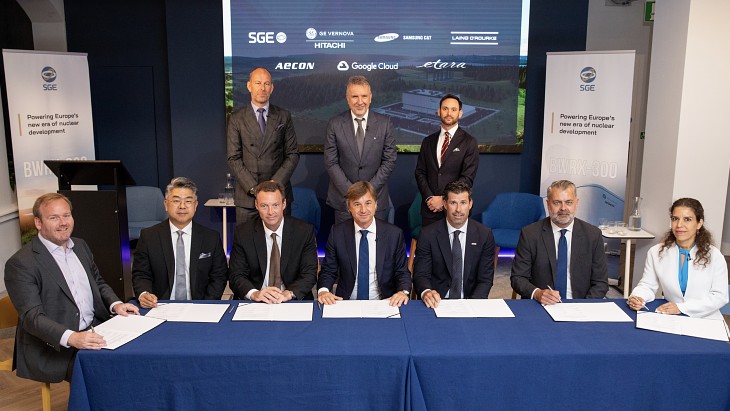
Kasprów, seated, centre, at June’s event outlining its UK fleet plan (Image: SGE)
The company has also developed plans for a fleet of SMRs in Poland and in June submitted its contract for difference application to the government there. As to which country’s projects might happen first, Kasprów says that the UK project could happen at the same time, praising the UK regulatory regime and its infrastructure.
He also rejected concerns about the capacity of supply chains and workforce to cope with the construction of Sizewell C and a number of SMR projects at the same time. He stressed the maturity of the BWRX-300 technology, its use of existing nuclear fuels and the example and experience of the first unit being constructed in Canada.
“We are using existing supply chains – there is also an advantage to the fleet approach because there are places where the supply chain exists, but maybe needs to scale up, and by coming to market with a 14-unit project as our starting point those companies can see a clear path to making that investment worthwhile,” said Robert Rudich, Chief Business Development Manager.
They also stress that the non-nuclear part of the plant is similar to conventional power plants, with the industrial giants GE Vernova and Hitachi as partners and all part of a Europe-wide supply chain.
GE Vernova Hitachi Nuclear Energy’s (GEVH’s) BWRX-300 is a 300 MWe water-cooled, natural circulation SMR with passive safety systems that leverages the design and licensing basis of GEVH’s US Nuclear Regulatory Commission-certified ESBWR boiling water reactor design and its existing, licensed GNF2 fuel design, a unique combination that GEVH says positions it to deliver an “innovative, carbon-free baseload power generation source” this decade.
The first BWRX-300 is under construction at Ontario Power Generation’s Darlington site in Canada, with completion expected by the end of the decade. The Darlington project is a reference project for OSGE.
Luba Kotzeva, founder and CEO of advisory and consultancy group Etara and part of the project team, said there had been “good engagement” with the UK side on the issue of a Contract for Difference funding model and stressed the importance of the proposal being for a fleet programme: “I think that is essential to getting the economies of scale, to getting the economics to flow, to getting the private capital.”
The example of the first SMR being built in a G7 country, at Darlington in Canada, is also seen as a key development. Kasprów said: “It’s extremely important, it is the difference between having something and nothing. It’s not about promises anymore – it’s happening.”