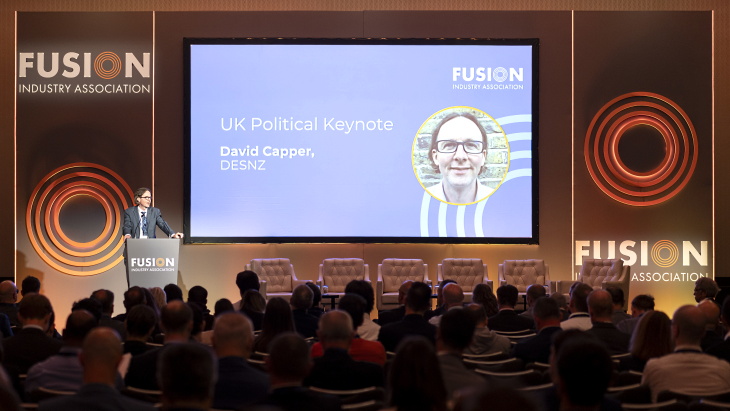
Speaking at the Fusion Industry Association’s UK Fusion Forum on 15 September, David Capper, who assumed the role of Director of New Nuclear and Fusion Energy at the Department for Energy Security and Net Zero (DESNZ) in June this year, said the UK’s fusion sector was moving rapidly from a research-focused activity towards an industrial proposition.
“What has struck me in these first few months is not simply the extraordinary science of fusion, but how rapidly fusion is becoming an industrial and commercial proposition,” he said. “The challenge before us is no longer simply proving the science, it is building the industry.”
The UK government is backing fusion research and commercialisation with more than GBP2.5 billion (USD3.3 billion) over five years, Capper said. The funding includes research and technology programmes, specialist facilities and the development of the Spherical Tokamak for Energy Production (STEP) prototype fusion power plant at West Burton in Nottinghamshire.
Capper said the UK was well placed to develop a fusion industry, citing more than 60 years of fusion research, public investment, a proportionate regulatory framework and a growing ecosystem of developers, national laboratories, engineering companies, specialist suppliers, universities and investors.
STEP role
The STEP programme is intended to play a role beyond demonstrating fusion technology, Capper said, by helping to develop the industrial capability, supply chains and skills required for future commercial fusion plants.
Tim Bestwick, CEO of UKAEA, similarly described STEP as a programme intended to address technical challenges while establishing engineering, regulatory, manufacturing and supply-chain capabilities.
“The opportunity, as you’ve heard, for the UK is translating research leadership into industrial leadership,” he said.
The economic opportunity could extend beyond electricity generation, Bestwick added, with technologies such as superconducting magnets, advanced materials, robotics, remote handling and digital engineering having potential applications in other markets.
The UKAEA has more than six decades of fusion research experience at its Culham Campus near Oxford and is the UK’s national fusion laboratory.
Bestwick said the UK had the main components of a fusion ecosystem, including research organisations, government-backed programmes, private companies, technology providers and an expanding industrial base. However, significant challenges remain.
“Commercial fusion electricity generation has not yet been demonstrated anywhere in the world,” he said. Once fusion electricity generation is demonstrated, it will also have to become commercially viable.
Programmes including STEP and LIBRTI (Lithium Breeding Tritium Innovation) are intended to address some of the technical challenges, but Bestwick noted that they continue to involve significant technical risk.
Lessons from fission
Lord Iain McNicol, Chair of the Nuclear Industry Association (NIA), said the UK’s established fission industry could provide useful experience as fusion moves towards commercial deployment. Fusion is a distinct technology with its own challenges, he said, but there are significant areas of overlap between the two industries.
“The United Kingdom was right to establish a proportionate regulatory approach rather than simply applying structures developed from fission,” he said. “But while fusion and fission are different, our industries … are not strangers. We’re sisters.”
The NIA has operated a fusion business group for several years, bringing together companies involved in engineering, construction, advanced manufacturing, materials, robotics, regulation and project delivery. McNicol said one lesson from fission was the need to develop the commercial framework for new projects before financing is required. “Brilliant technology will not reach the grid without investable projects,” he said.
A second lesson was the need to develop supply chains before construction begins, rather than attempting to establish them once projects are under way. Fusion will require capabilities in areas including advanced materials, high-temperature superconducting magnets, precision manufacturing, digital engineering, fuel-cycle technologies and complex systems integration, he said.
The NIA represents more than 300 companies across the UK nuclear supply chain. McNicol said many already possess skills and experience relevant to fusion projects, including the delivery of safety-critical infrastructure and complex programmes.
Skills and supply chains
The availability of skilled workers will also be critical as the industry develops. “Projects do not fail only because they lack finance and technology,” McNicol said. “They fail when there are not enough engineers, technicians, welders, project managers and yes regulators.” The government expects its fusion programme to support more than 10,000 jobs by 2030 and train more than 2,000 people in fusion-related disciplines.
Capper said the government wanted to attract international companies and investors to the UK while encouraging established engineering and manufacturing businesses to view fusion as an emerging commercial market. “Our objective is to create an ecosystem capable of supporting a globally diverse fusion industry,” he said. That would require progress on skills, regulation, finance, sites and international partnerships alongside the development of fusion technology.
“Technology without industrial capacity will not deliver commercial plants,” Capper said. “Investment without credible markets will not be sustained.”
He said the government would continue to implement its fusion strategy, including development of STEP and a market framework for fusion energy, but added that government could not establish the industry alone. “We need industry to tell us where barriers remain,” he said, calling for developers, established industrial companies, investors and international partners to work with government on the requirements for future deployment.
Commercial transition
The speakers’ comments underline the UK’s shift from a focus primarily on fusion research towards preparations for commercial deployment. For UKAEA, government and industry, the next stage involves not only demonstrating the technical feasibility of fusion but establishing the industrial infrastructure needed to build and operate future plants.
Bestwick said the UK had “the ingredients of a fusion ecosystem”, including a world-class research base, a national strategy, major programmes, private companies and an increasingly capable supply chain. “The key challenge to the UK is transforming that scientific excellence into globally competitive businesses,” he said.
Capper said the UK had moved from a legacy of scientific leadership towards an ambition for commercial leadership. “The UK intends to be at the centre of that transformation,” he said.