

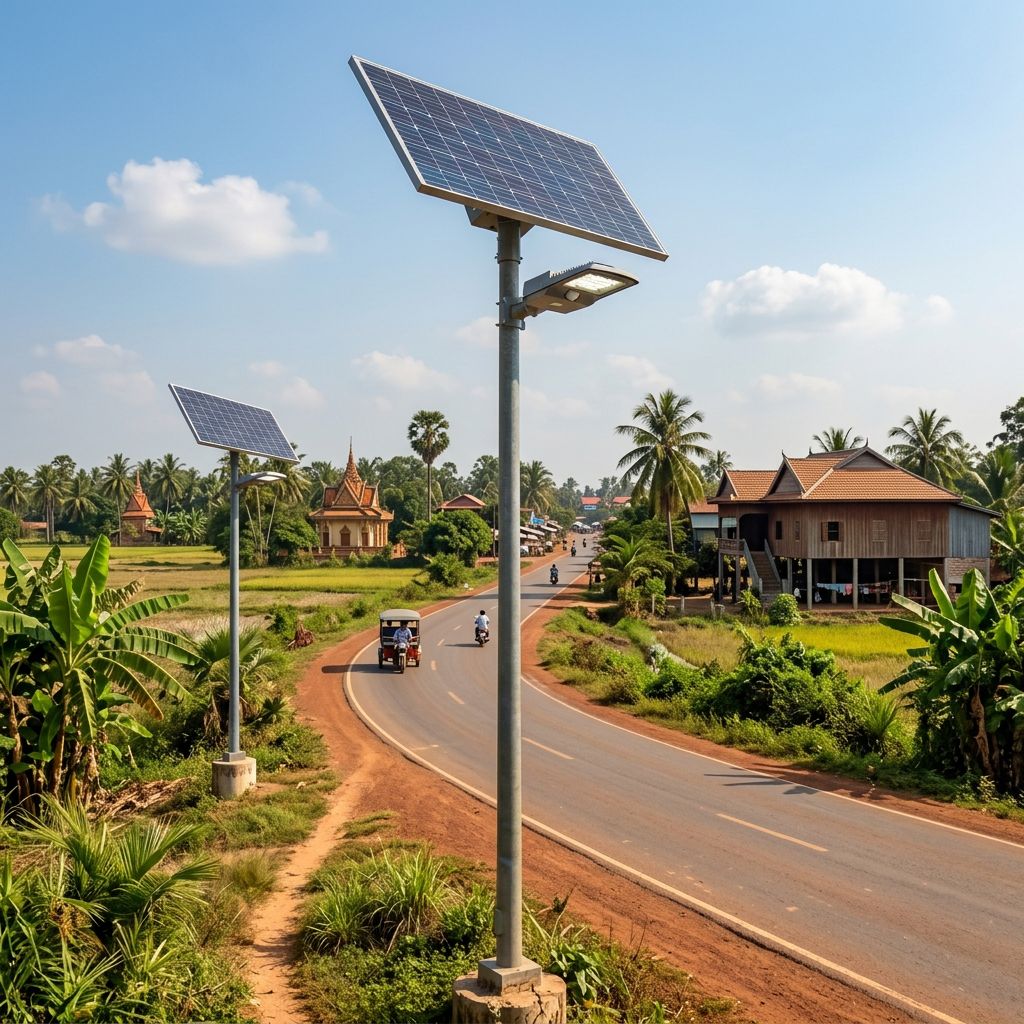
Cambodia has started a major programme to install solar-powered street lights across 13 provinces and Phnom Penh, with the aim of improving road safety, public security and visibility for people travelling at night. The project will cover around 1,200 kilometres of public roads and is being implemented with an initial investment of approximately $6 million.
The first phase is being carried out through cooperation between the Ministry of Public Works and Transport, the Ministry of Mines and Energy, and provincial administrations. The programme includes Phnom Penh, Kandal, Battambang, Siem Reap, Pursat, Takeo, Kampong Cham, Kampong Speu, Banteay Meanchey, Kep, Kampot, Kampong Chhnang, Koh Kong and Preah Sihanouk.
Prime Minister Hun Manet has supported the initiative and indicated that the government could eventually extend solar street lighting to all 25 provinces and the capital. Speaking during a ceremony marking the inauguration of sections of National Road 1 on October 1, he said infrastructure projects serving the public were an important responsibility of the government.
The initiative follows a memorandum of understanding signed on July 14 between the Ministry of Mines and Energy and the Ministry of Public Works and Transport. The agreement established cooperation for installing solar-powered lighting along public roads.
Installation work has already started in Battambang, Pursat and Kampong Chhnang. During the initial stage, solar lights are being deployed along major national highways connecting Phnom Penh with other parts of the country. These include National Roads 1, 2, 3, 4, 5 and 6.
The government plans to subsequently expand the programme to other important routes, including National Roads 10, 48 and 21. Over time, the initiative is expected to cover additional national and public roads across Cambodia.
Minister of Mines and Energy Keo Rattanak said the project is expected to be completed within two years. He said better lighting would improve visibility, contribute to safer road travel, enhance the appearance of highways and strengthen security in areas used by the public at night.
However, authorities and civil society representatives have pointed out that street lighting alone will not eliminate road accidents. Am Sam Ath, director of general affairs at Cambodian human rights organisation Licadho, said improved lighting could help drivers see roads and surrounding conditions more clearly, but road safety also depends on responsible behaviour.
He stressed the importance of following traffic regulations and avoiding driving under the influence of alcohol. Effective enforcement of traffic laws, combined with improvements to road infrastructure, will therefore remain essential to reducing accidents.
The solar street-lighting programme forms part of Cambodia’s broader efforts to improve public infrastructure while supporting safer and more secure travel after dark.









)
