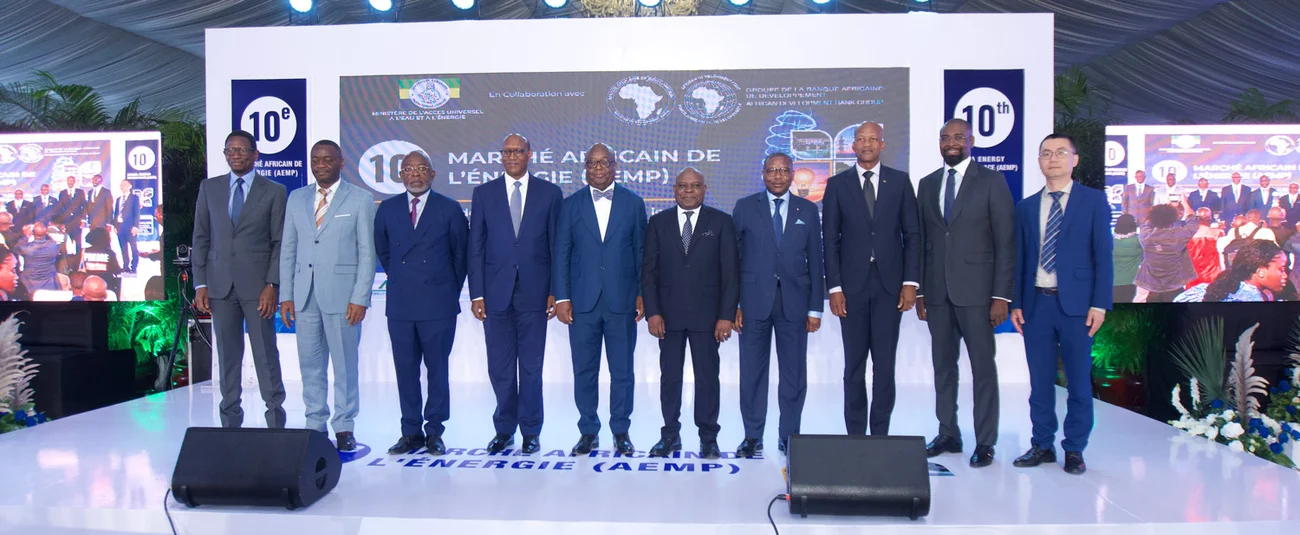
The African Development Bank African Development Bank, in partnership with the Government of Gabon Government of Gabon, has concluded the 10th edition of the Africa Energy Market Place (AEMP) Africa Energy Market Place in Libreville. The two-day forum, held on 8–9 April 2026 at the Nomad Suites Residence in Libreville, brought together senior policymakers, development partners and private-sector leaders to advance reforms and investment priorities aimed at unlocking Gabon’s energy potential and supporting the continental Mission 300 initiative.
Mission 300 Mission 300 is a joint effort between the African Development Bank and the World Bank Group World Bank Group that seeks to connect 300 million Africans to electricity by 2030. Within this target, the Bank Group has committed to enabling access for 50 million people. The Libreville forum served as an opportunity for Gabon to position its national energy goals within this regional framework, aligning its priorities with the Mission 300 roadmap and advancing the development of a comprehensive National Energy Compact.
Launched in 2018, the AEMP is the African Development Bank’s main energy-sector policy dialogue platform under the Africa Energy Technical Assistance Programme Africa Energy Technical Assistance Programme. Gabon became the 25th country to join the platform, following 24 other African nations. This edition provided a structured space for the country to refine its policy and investment agenda, mobilise financing, and coordinate government and development partner efforts.
Dr Kevin Kariuki Kevin Kariuki, Vice President for the Power, Energy, Climate and Green Growth Complex at the African Development Bank Group, emphasised the importance of sustained reform. He noted that Gabon’s progress—marked by strong political ownership, a clear Energy Compact and a commitment to transforming plans into implementable projects—reflects the critical role of the private sector in delivering Mission 300.Dialogue sessions during the forum centred on the five strategic pillars of Gabon’s draft National Energy Compact.
These included expanding electricity generation and modernising the grid; enhancing regional power integration through the Economic Community of Central African States (ECCAS) Economic Community of Central African States, the Central African Economic and Monetary Community (CEMAC) Central African Economic and Monetary Community and the Central African Power Pool (PEAC) Central African Power Pool; scaling up distributed renewable energy and clean cooking solutions; encouraging private-sector investment through innovative financing and public–private partnerships; and improving the financial viability and governance of the national utility, SEEG Société d’Energie et d’Eau du Gabon.
Discussions covered the full electricity value chain, with particular attention to rural electrification challenges.Wale Shonibare Wale Shonibare, Director for Energy Financial Solutions, Policy and Regulation at the African Development Bank Group, described the meetings as highly productive. He highlighted that the AEMP’s purpose is to build the enabling environment required to attract private investment and mobilise financing from development banks, donors and commercial partners.
According to him, Gabon’s strong government leadership was key to shaping a robust National Energy Compact and laying the foundation for implementation.Gabon enters this process with relatively high levels of energy access: about 94 percent of the population has electricity and around 90 percent has access to clean cooking. However, these benefits remain concentrated in urban areas, leaving rural communities underserved.
The forum also examined a significant structural issue within the national power system: although some regions have surplus generation capacity, others experience persistent shortages due to the existence of four isolated grids that are not yet interconnected. Establishing a unified national grid and integrating Gabon into the Central African Power Pool and the wider regional energy market under the African Continental Free Trade Area African Continental Free Trade Area were identified as key priorities for long-term energy security and economic development.
The forum resulted in several notable outcomes. These include the preparation of a Gabon Energy Access Investment Brief aligned with Mission 300, agreement among stakeholders on priority renewable energy and grid expansion projects, draft policy and regulatory reform recommendations with identified implementation timelines and the creation of a Compact Delivery and Monitoring Unit (CDMU) to serve as the government’s mechanism for implementation and accountability.
Work on executing the National Energy Compact is expected to begin in the coming months, supported by the momentum generated through the AEMP process.AEMP-Gabon was jointly organised by the African Development Bank and the Government of Gabon, with co-convening partners including the World Bank, SEEG, ECCAS, the Central African Power Pool, UN Sustainable Energy for All (SEforALL) Sustainable Energy for All, the Africa Minigrids Developers Association (AMDA) Africa Minigrids Developers Association and the Africa Renewable Energy Initiative (AREI) Africa Renewable Energy Initiative.
Subscribe to get the latest posts sent to your email.