Monday, 23 December 2024
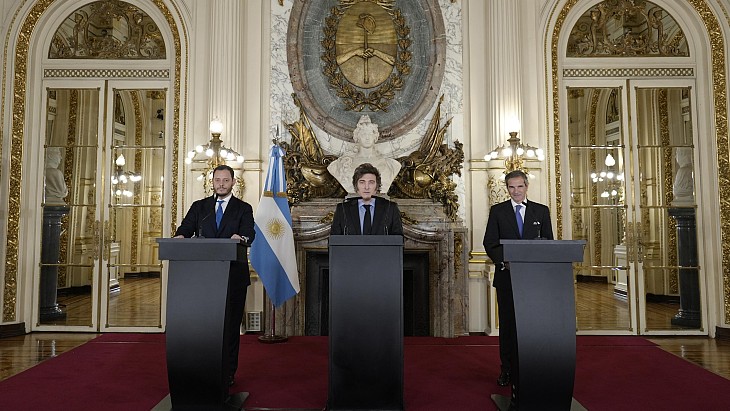
The president, standing between his chief adviser Demian Reidel, who will oversee a new nuclear programme, and International Atomic Energy Agency Director General Rafael Mariano Grossi, said “we are contemporaries of a true technological revolution … the development of artificial intelligence opens a new frontier for this manifest destiny that we share as a species” but “many of the free nations that have always been at the forefront of technological development are now afraid of innovation and punish the technological sector with taxes and regulations”. Argentina by contrast was “removing the regulations that have tied the hands of our people for decades and inviting the world’s big capitals to cooperate with Argentina”.
He added: “The potential for development in artificial intelligence is so immense that conventional energy will not be enough to supply this new demand, which is why we are convinced that a resurgence of nuclear energy will occur throughout the world, because despite the countless campaigns of discredit that some international foundations have mounted, nuclear energy is the only source that is sufficiently efficient, abundant and rapidly scalable to cope with the development of our civilisation.
“So, after decades of decline, nuclear energy will make its triumphant return and we will not only not be left behind, but we intend to be pioneers.”
The outline of the plan announced, according to various reports, is initially for the construction of a small modular reactor on the Atucha site. According to the Financial Times,Reidel said the plan was to use Argentine technology, developed by its nuclear engineers, but with funding from a US investor joining a joint venture with Invap, with the goal of having a first plant online by 2030. No mention was made during the announcement about the existing Argentine SMR project, the CAREM-25.
The second stage of the government’s nuclear plan is reported to be to develop uranium reserves to cover domestic demand and position the country as an exporter of high-value-added fuel elements.
Grossi said that the IAEA had signed a memorandum of understanding agreement with Argentina following the announcement, which aimed to expand their collaboration on small modular reactors “to meet the energy demands of data centres and AI applications”.
The background
Argentina currently has three operable nuclear power units – Atucha 1, connected in 1974, Atucha 2, which was connected in 2014 and Embalse which was connected to the grid in 1983. Between them they generate about 5% of the country’s electricity. There have been plans for a fourth unit, as Atucha III, with an EPC contract signed with China’s CNNC in February 2022. It is unclear what the current status is of this project and whether it will be part of the nuclear programme.
The CAREM SMR – the name comes from Central Argentina de Elementos Modulares – is a 32 MWe prototype and is Argentina’s first domestically designed and developed nuclear power unit. First concrete was poured in 2014, but construction has since been suspended a number of times. It is currently estimated to be about two thirds complete, and a Critical Design Review was ordered for it in May this year with reported uncertainty over funding.