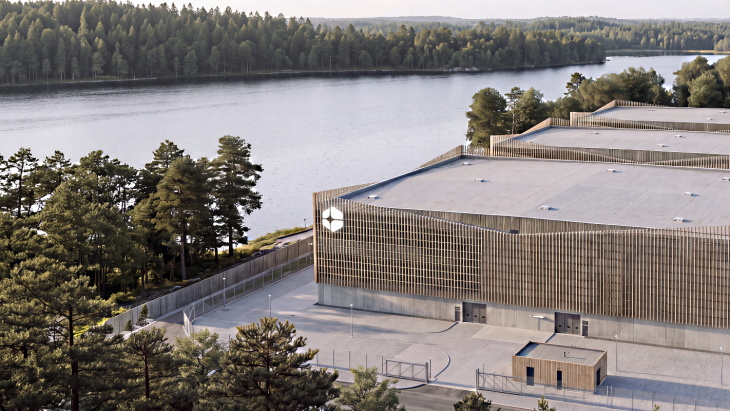
On 25 August, Blykalla submitted a proposal to the Swedish government for a nuclear power plant at Untra which would feature up to eight lead-cooled small modular reactors (SMRs) with a total capacity of up to 440 MWe. The application followed an earlier one, submitted in May, for a six-unit project in Norrsundet in the Gävle municipality, which is also in the same region of east central Sweden.
Blykalla has established Untra Nuclear Power AB as the licence holder and financing vehicle for the Untra plant, with strategic and financial investors expected to enter its ownership over time. Blykalla – through Untra Nuclear Power – has now applied for state support for the construction of the Untra plant, having applied in early June for government financing for its planned power plant in Norrsundet.
The Swedish state aid framework is designed to support new nuclear power through a state loan, a two-way contract for difference and a risk-sharing mechanism. The detailed terms of the state aid are agreed between the project company and the Swedish state, and any support would require approval by the European Commission in accordance with EU State aid rules. Negotiations on the terms of state support begin once the government decides to proceed with the application.
Following the receipt last week of Blykalla’s application to establish the nuclear power plant at Untra, the government has tasked the County Administrative Board in Uppsala County with preparing a proposal for a facility plan. This plan will guide how land and water areas should be used when establishing a nuclear facility. According to recent legislation, the government may approve an application if there is a valid facility plan for the facility in question. The proposed construction plan must be accompanied by an environmental impact statement and a plan description. This statement must include a description of the planning conditions and how the plan can be implemented. The plan must be submitted no later than 30 April 2027.
“With an efficient review process, the first reactor at Untra can be in operation during the first half of the 2030s,” Blykalla said.
“The need for dispatchable power in this part of Sweden is significant and growing,” said Jacob Stedman, CEO of Blykalla. “Building small and modular means we can meet it close to where it arises, on sites that were not previously available for nuclear. It’s a step toward a more robust clean energy system.”
Blykalla – formerly called LeadCold – is a spin-off from the KTH Royal Institute of Technology in Stockholm, where lead-cooled reactor systems have been under development since 1996. The company – founded in 2013 as a joint stock company – is developing the SEALER (Swedish Advanced Lead Reactor). The company’s goal is for its first 140 MWt/55 MWe SEALER-55 commercial reactor to be ready for operation in the early 2030s.
In October 2022, Sweden’s incoming centre-right coalition government adopted a positive stance towards nuclear energy. In November 2023, it unveiled a roadmap which envisages the construction of new nuclear generating capacity equivalent to at least two large-scale reactors (2,500 MWe) by 2035, with the equivalent capacity of up to 10 new large-scale reactors (which may include SMRs) coming online by 2045. A new act on state aid entered into force on 1 August 2025, since when interested companies have been able to apply for the aid.
So far, approval has been sought for nuclear facilities at five sites with a total output of up to 3,700 MWe. In addition, the government has received applications for financial support to build nuclear reactors at two additional locations, with seven projects applying for state aid.