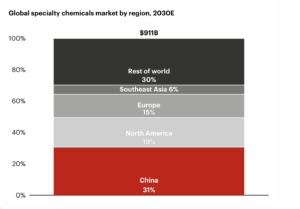
The global chemicals industry will need to close around 35 million tonnes of olefin production capacity by 2030 to restore normal operating rates, according to new analysis from Bain & Company.
The forecast, equivalent to approximately 7.5% of global capacity, comes as results from industrial gas majors reveal a widening regional divide in chemical-sector demand.
Bain describes the downturn as a structural reset, warning that record plant closures and demand growth will be insufficient to eliminate persistent overcapacity.
Chronic overcapacity, pressure on margins, and continued expansion in China are reshaping the global chemicals industry, while demand growth alone is unlikely to restore historical plant utilisation rates by 2030.
“The chemical industry’s old downturn playbook of cutting costs, protecting the balance sheet, and waiting for demand to recover is no longer feasible,” said Piet de Paepe, Global Head of Bain’s Chemicals Practice.
“Companies need to be much more selective about where they compete, concentrating investment in products and regions where they can establish a clear advantage, rather than waiting for the .”
Industrial gas majors report mixed demand
The regional divide is also reflected in recent financial disclosures from leading industrial gas suppliers, whose operations are closely linked to chemicals and refining through hydrogen, carbon monoxide, nitrogen, and other gas supplies.
Air Liquide reported weaker chemical-sector demand in Europe during the first quarter of 2026, with Large Industries revenue in its Europe, Middle East and Africa (EMEA) business declining 3.0%.
The company attributed the fall partly to lower hydrogen sales and reduced cogeneration activity, while Industrial Merchant volumes were also affected by weak demand from chemicals and food and beverage customers.
Linde reported a similar trend in the first quarter, with underlying EMEA volumes falling 3% year on year, primarily due to weaker activity in its chemicals and energy and manufacturing markets.
However, conditions have been more favourable elsewhere. Linde’s Asia Pacific business recorded 6% underlying volume growth during the quarter, supported by electronics, chemicals and energy demand, and new project start-ups.
Air Products also reported stronger on-site gas activity in its fiscal third quarter of 2026, with Americas volumes increasing 7%, including growth from hydrogen and carbon monoxide facilities and a new on-site asset. Asian volumes rose 6%, supported by higher on-site demand, new facilities and improved helium volumes.
Despite the pressure on established chemical production centres, industrial gas suppliers continue to secure significant investments linked to new chemical facilities.
Chemicals accounted for 64% of Linde’s $7.1bn sale-of-gas project backlog at the end of the first quarter of 2026, highlighting the sector’s importance to the group’s future investment pipeline.
Air Liquide has also announced more than $200m of investment to expand supporting chemicals firm Oxea in Texas.
In Kazakhstan, the company is to supply nitrogen and compressed dry air to Silleno’s planned polyethene complex, with initial gas deliveries targeted for the end of 2028.
Feedstock economics drive regional shift
Bain identified a widening competitive divide between ethane-based and naphtha-based chemical production.
US ethane is expected to remain around $300 to $400 per tonne cheaper than Asian naphtha, providing a lasting feedstock cost advantage to producers in the US and Middle East.
More than half of the cracker fleets in Europe, Eastern Asia, and Southern Asia depend on naphtha, leaving those regions particularly exposed to competitive pressures.
By 2030, Bain expects nearly 70% of global ethylene production capacity to be concentrated in China, the Middle East, and North America.

© Bain & Company
The consultancy anticipates further closures of high-cost and Northeast Asia, while China is expected to become a net exporter of most base chemicals.
The shift in petrochemical production could reshape industrial gas demand, placing pressure on established supply networks in regions facing closures while creating opportunities for new on-site investments in more competitive markets.
Bain recommends that decisions on closing or converting high-cost, carbon-exposed assets be made within the next 12 to 18 months, highlighting the potential pace of further restructuring.