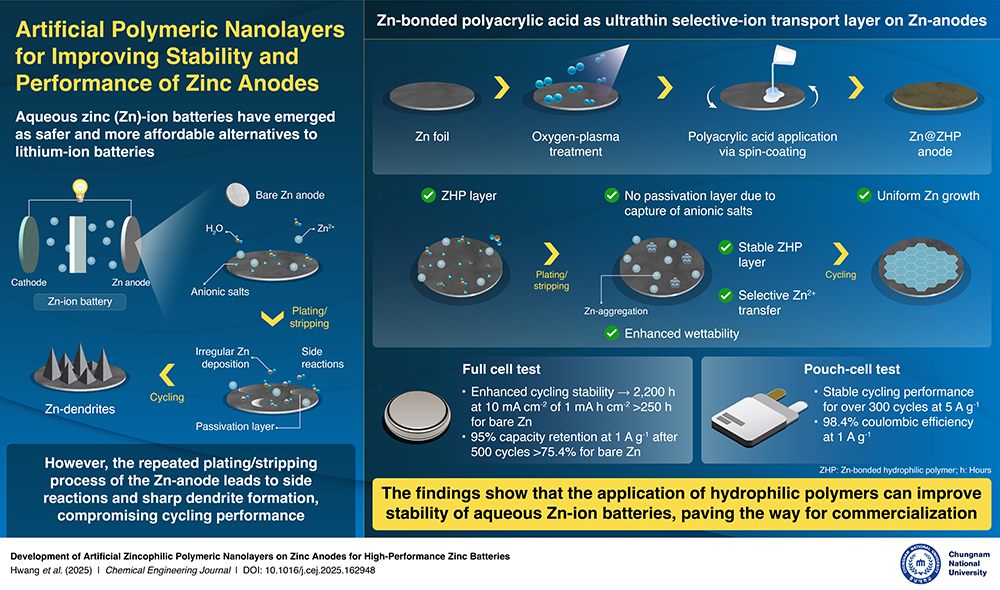
A research team at Chungnam National University (CNU) has developed an innovative protective coating for zinc-ion batteries (ZIBs) that could pave the way for safer, more stable, and cost-effective energy storage solutions. The new zinc-bonded polyacrylic acid (ZHP) nanolayer prevents the formation of dendrites and suppresses side reactions, addressing two major challenges that have hindered the commercial viability of ZIBs.
Zinc-ion batteries are emerging as a promising alternative to lithium-ion batteries, offering lower costs and enhanced safety through the use of water-based, non-flammable electrolytes. However, repeated plating and stripping of zinc anodes during charging and discharging often trigger dendritic growth and corrosion, reducing cycle life and performance.
The CNU team, led by Associate Professor Woo-Jin Song of the Department of Organic Materials Engineering, tackled this challenge by creating a nanoscale selective-ion transport layer (SITL) from polyacrylic acid (PAA). The researchers employed oxygen plasma treatment to improve adhesion between the coating and the anode surface, followed by a scalable spin-coating process and heat treatment to form the ZHP layer.
Unlike traditional protective coatings, which can be thick, complex, and costly to manufacture, the ZHP layer is ultra-thin, easy to fabricate, and compatible with large-area applications. Its hydrophilic nature improves zinc-ion transfer and ensures uniform ion distribution, significantly enhancing electrochemical stability. Laboratory tests demonstrated that ZHP-coated zinc anodes (Zn@ZHP) resisted dissolution even under harsh conditions and maintained uniform zinc deposition along the (002) crystallographic plane.
Performance results were striking: the Zn@ZHP anodes operated stably for over 2,200 hours in symmetric cells, retained 95% capacity after 500 cycles in full cells at 1 A g⁻¹, and delivered reliable performance in pouch cells for more than 300 cycles at high current densities of 10 mA cm⁻².
“The enhanced stability of aqueous zinc-ion batteries makes them ideal for safety-critical industries such as grid-scale storage and detection sensors,” Dr. Song stated. “Their low cost and non-toxicity also position them well for portable electronics and wearables.”
Published in the Chemical Engineering Journal on July 1, 2025, this work marks a significant advance toward practical next-generation ZIBs. With the ZHP layer’s durability, scalability, and performance, CNU’s breakthrough could accelerate the adoption of zinc-based batteries in a wide range of applications.
Subscribe to get the latest posts sent to your email.