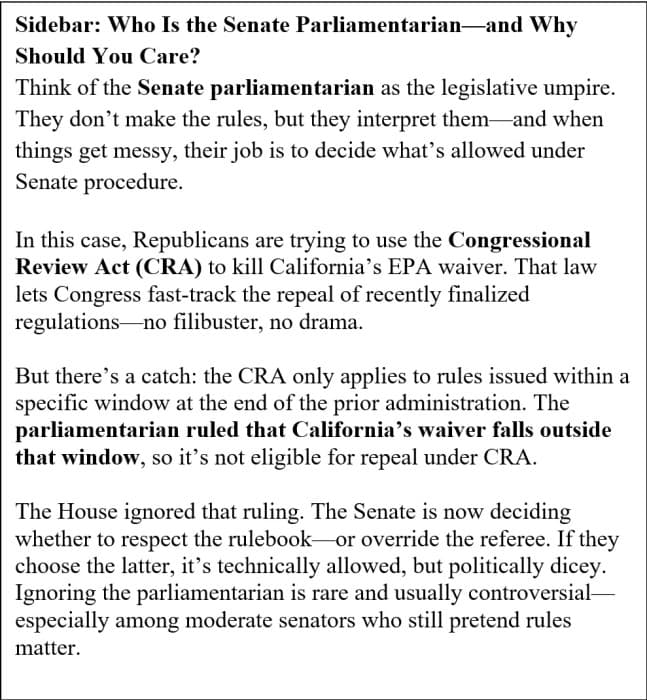
California’s 2035 gas car ban just got torched by the U.S. House, which voted 246–164 on Thursday to kill the EPA waiver that let the Golden State set stricter tailpipe rules than the federal government. The decision doesn’t just mess with California—it upends the dozen other blue states that hitched their EV ambitions to Sacramento’s regulatory wagon. Now the Senate will get a turn at the wheel, but it’s already swerving around a ruling from the Senate parliamentarian that says this repeal isn’t even allowed.
For years, California has acted like it’s the de facto EPA. Under Newsom’s zero-emission-or-bust vision, gas cars were set to become fossils by 2035.
“This is the most impactful step our state can take to fight climate change,” California Governor Newsom said in 2020. “For too many decades, we have allowed cars to pollute the air that our children and families breathe. Californians shouldn’t have to worry if our cars are giving our kids asthma. Our cars shouldn’t make wildfires worse – and create more days filled with smoky air. Cars shouldn’t melt glaciers or raise sea levels threatening our cherished beaches and coastlines.”?
Except the federal government no longer appears to be on board.
Meanwhile, the actual driver of the EV revolution, Elon Musk, is watching the drama unfold from Texas—where he moved Tesla’s HQ after tiring of California’s red tape and high taxes. Left-leaning pundits once praised Musk as a green tech savior—the one to someday send gasoline engines to the grave.
Now they’re setting fire to Teslas (literally), slamming him for his role with DOGE, and—just this morning—cheering a Wall Street Journal article claiming Tesla’s board was preparing to oust him as CEO.
Musk says the claim was bogus and that Tesla told the WSJ that before publication. The paper ran the piece anyway.
Tesla stock has been bleeding for months, in part due to his newfound position as the left’s punching bag, and in part because the EV market has matured, subsidies are waning, and some are coming to the realization that the green revolution is a lot more complicated—and expensive—than campaign speeches suggest.
And somewhere in Texas, Elon’s probably retweeting the news with a flamethrower emoji, displaying the delicious irony of the EV king pushing back against the political class that he bashes daily—even when they were previously rooting for Tesla’s success. Musk has been an advocate of a gradual transition and has shied away from demonizing the oil and gas industry.
The alliances have scrambled. The EV King is at war with climate crusaders, while Republican fossil fuel champions are rushing to buy Teslas in solidarity with Musk. Tesla’s founder is now the darling of oil-patch Twitter, and the party of states’ rights and deregulation just torpedoed a policy they might’ve embraced—if only it hadn’t come from a state they loathe, targeting an industry they love.
By Julianne Geiger for Oilprice.com
More Top Reads From Oilprice.com
- Crude Oil Inventory Gain Outshone By Product Draws
- Oil Prices Drop as Supply Concerns Continue
- World Bank: Get Ready for a Commodity Price Freefall