The energy cluster model would see large consumers take their electricity or heat directly from one or more co-located reactors, large or small. While the consumers benefit from energy that is more reliable, resilient, secure and clean than grid supply, the nuclear developer would benefit from the simplified project finance that comes with having such committed partners.
It would also be a benefit for both the consumers and the nuclear developer to avoid long transmission lines and to reduce the burden the cluster’s grid connection would place on grid resources, which are at a premium in most markets.
Surging demand from data centres to meet the needs of artificial intelligence and other cloud services are one main driver of the trend. Co-location is already happening in some places, notably where data centres have been built alongside existing nuclear power plants at Susquehanna in the US and in recent years at Kalinin in Russia. Looking ahead, several small reactor companies are vying for data centre supply contracts and X-energy’s Ben Reinke noted that the surety of its 1 GWe contract with Amazon gave its supply chain the confidence to make necessary capital investments.
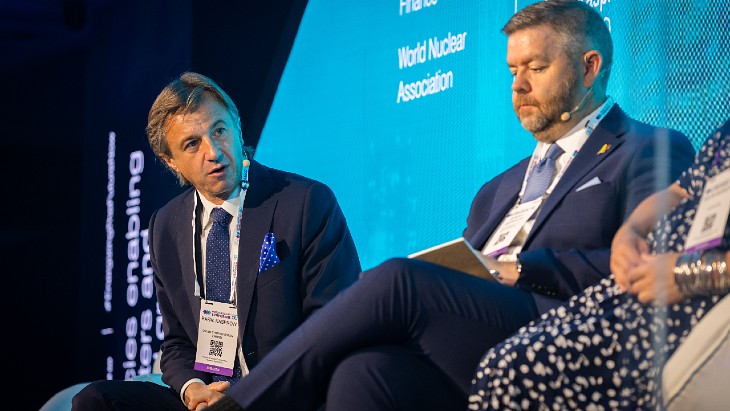
In Poland, five of the six locations identified by Orlen Synthos Green Energy would be based on clustering, said company CEO Rafał Kasprów. He noted that Poland also consumes some 55 GWt of district heating nationally, including 4.6 GWt in Warsaw. “It is not feasible to build cables and electrify,” he said, “Easier to replace the source of energy and that’s why we focus on SMRs for heat production.”
In the Netherlands a study by developer ULC looked at the co-location of two Rolls-Royce SMRs with a hydrogen production facility using high temperature electrolysis. Company CEO Dirk Rabelink said it found this to be feasible, especially when compared with strategies based on enormous overbuilding of variable renewables.
As well as producing hydrogen towards the European Union’s targets, the facility could provide other services, said Rabelink. By keeping the electrolyser in a hot standby using nuclear heat in the form of steam, the system could respond to grid fluctuations “in milliseconds”, said Rabelink, thereby supporting grid stability.
Given that the Netherlands’ grid will probably be dominated by offshore wind in decades to come, Rabelink said the nuclear hydrogen facility could also generate revenue by switching to put some of its electricity onto the grid when market conditions are favourable.
One very serious advantage of energy clusters to those countries that develop them is energy security, said Kasprów. The potential to give key industries the most resilient and secure energy supply possible, which is free from the influence of fossil fuel markets, is strategically attractive.
Open Group
Separately, the conversation around energy clusters expanded on 2 September with the formation of the Industrial Advanced Nuclear Consortium. Under the banner of The Open Group, founder members Chevron, ConocoPhillips, ExxonMobil, Freeport-McMoRan, Nucor, Rio Tinto, and Shell said they would “leverage their integration and project delivery expertise to define the requirements for the application of nuclear technology to provide process heat and power for their respective industries”. They plan to engage with the US Nuclear Regulatory Commission.
“There is an urgent need to better leverage nuclear energy to address the application of heat and power solutions. We believe that an open architecture approach can enable cost effective solutions that can be replicated to drive this adoption,” said Steve Nunn, President and CEO of The Open Group. “By bringing together large industrial end users and the supplier community, we can draw on the huge amount of industry expertise in project delivery, reduce cost and schedule uncertainty, and effectively deliver nuclear projects that serve the needs of the industry.”