Thursday, 23 January 2025
Rosatom says that, if the proposed VVER-S reactors can use a full load of MOX fuel, it will cut its use of natural uranium by 50% and, over its lifetime – with high uranium prices – could save about the same amount as the capital cost of a unit.
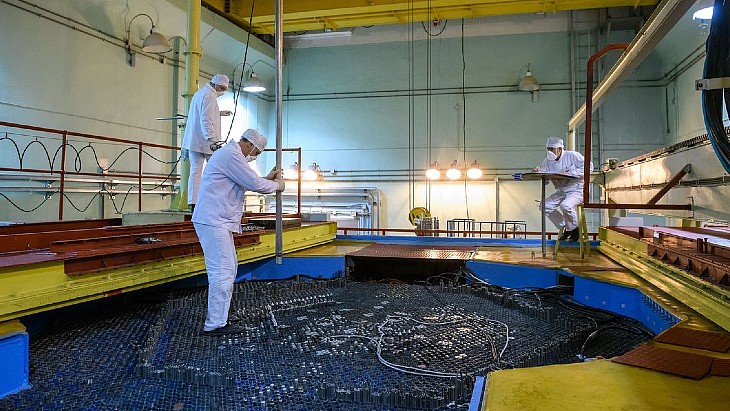
The testing is being carried out in Dimitrovgrad by the Research Institute of Atomic Reactors (JSC RIAR), which is part of Rosatom’s science division. MOX fuel is manufactured from plutonium recovered from used reactor fuel, mixed with depleted uranium. It allows the recycling of used nuclear fuel, thus helping to close the fuel cycle.
The first two cycles of the testing, which began in 2023, has achieved the target level of nuclear fuel burnup, Rosatom said, and “all fuel elements have retained their tightness. The test programme is designed for six cycles, the behaviour of fuel elements is being studied under nominal operating parameters, as well as in the modes of disruption of normal operation and design-basis accidents”.
Russia’s state nuclear corporation also said that regulator Rostekhnadzor has issued a licence for fuel elements with MOX fuel to undergo a set of neutron-physical experiments at the BFS-1 critical test facility. “Based on the results of the research, Rosatom scientists intend to substantiate the efficiency and safety of using MOX fuel in VVER-type reactors (including future advanced installations),” Rosatom said.
In Russia, MOX fuel is currently produced for fast neutron reactors, notably the BN-800 fast reactor at Beloyarsk. Uranium-plutonium REMIX fuel has been developed for VVER reactors. Rosatom says: “The introduction of MOX fuel in VVER reactors opens up new possibilities. The plutonium content is several times higher compared with REMIX fuel, and in addition, it contains depleted uranium, not enriched uranium. In the long term, this will make it possible to optimise the fuel fabrication economy, use regenerated nuclear materials more flexibly, and use the depleted uranium reserves accumulated in the industry.”
The company says that if the VVER fuel assembly is equipped with 25% fuel elements based on MOX fuel, and the remaining 75% with standard fuel elements with enriched uranium “then in terms of plutonium content this will be equivalent to a REMIX fuel assembly, consisting entirely of fuel elements based on uranium-plutonium fuel. The working name for such a hybrid fuel assembly with a mixed type of fuel is heterogeneous REMIX”.
Alexander Ugryumov, Senior Vice President for Scientific and Technical Activities of TVEL, Rosatom’s fuel company, said: “The justification of MOX fuel for VVER solves two key problems. The first is to increase the economic efficiency of closing the fuel cycle. The world knows the practice of using MOX fuel in light-water reactors with a load of up to a third of the core, but these full-scale MOX fuel assemblies, unlike irradiated REMIX fuel, cannot be reprocessed after operation to produce similar fuel. However, hybrid fuel assemblies with MOX fuel elements (the so-called “heterogeneous REMIX”) can be recycled multiple times. The second task is related to the full loading of VVER-S reactors with MOX fuel.”
The VVER-S is a 600 MWe water-cooled reactor. The fundamental difference for VVER-S compared with other VVER reactors is in spectral regulation “of the change in the reactivity margin of the core during fuel burnout due to a change in the water-uranium ratio and the complete rejection of liquid boron regulation during reactor operation at power. In the VVER-S, excess neutrons, instead of being absorbed in boric acid, are absorbed by uranium-238” which produces plutonium, a new fissile fuel. The first two units are planned as part of Kola 2 in the Murmansk region, with construction due to begin in 2028 with a commissioning target for 2035.