Wednesday, 22 January 2025
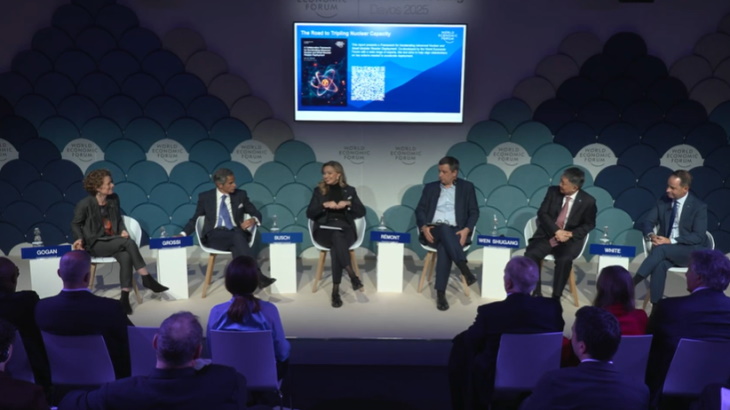
“This is a real milestone for the World Economic Forum,” noted session moderator Kirsty Gogan, Founding Director and Co-CEO of Terra Praxis, “This is the first publicly facing panel that’s ever been hosted on nuclear energy at Davos.”
She said the world is at a “pivotal moment … thirty countries have pledged to triple nuclear capacity by 2050. Now achieving that target would represent a construction rate of around 30 gigawatts a year, each year, for 20 years, starting in 2030. And that’s not all. Industrial energy users are signalling their demand for hundreds of gigawatts of clean energy to power their business-critical operations.”
Gogan said that major financial institutions were changing their stance on financing nuclear projects, signalling “a real shift in the way that capital markets are viewing nuclear energy”. However, if there is to be a tripling of nuclear capacity, we must “fundamentally transform the way that we design and deliver nuclear energy”.
Ebba Busch, Sweden’s Deputy Prime Minister and Minister for Energy, Business and Industry, said there had been a shift in support for nuclear energy over recent years. She said this had been driven by three things “it’s facts, it’s physics, and a need of hope for the future”.
She added: “I’m on a global mission to take politics out of energy policy and put physics back in because it’s really hard to do a competitive green transition without a lot of baseload, dispatchable energy – that is, 24/7 365 days a year. You’re not going to be able to electrify your heavy industry.”
There are three primary factors driving interest in nuclear energy, according to Wen Shugang, Chairman of China Huaneng Group. Firstly, “it is just becoming increasingly clear to a lot of people that nuclear is low-carbon”. Secondly, the industry is using cutting-edge technology to ensure the safety of nuclear power plants. “The regulators are now holding us to the highest standards as well, so there is even more of a safeguard when it comes to safety,” he said. Thirdly, nuclear can be used for more than just electricity generation.
International Atomic Energy Agency Director General Rafael Mariano Grossi said that while China’s nuclear industry was probably positioned to triple the country’s nuclear capacity by 2050, “in the West there are challenges, but the industry I think can be up to the challenge but certain things must change, or certain things must be done to get to that, and that has different dimensions – regulatory dimensions, financial dimensions, industrial, technological dimensions and political dimensions as well”.
“Yes, we have been facing some headwinds – including some political events – for a number of years,” said EDF Chairman and CEO Luc Rémont. “Now we are at the point where I think our manufacturing industry is totally ready to manufacture all the components that are going into nuclear power plants.
“But we need to learn back, as we did before – we used to be connecting to the grid five rectors per year 30 years ago. Now our Chinese friends are doing ten per year. In the meantime, the West stopped delivering new reactors. So, we need to accelerate the pace of construction by repeating the same thing and not reinventing the wheel from one reactor to the next.”
With regards to financing nuclear projects, Darryl White, CEO of BMO Financial Group, noted there have been positive moves recently. “The challenge is we don’t have full alignment on frameworks and taxonomies, and we see it developing. We see some progress in many, many places, but we don’t see it everywhere.”
He said the “enormous” challenge of financing these projects over the next 25 years is probably “understated and probably misunderstood by many participants in the ecosystem”.
In October 2022, Sweden’s incoming centre-right coalition government adopted a positive stance towards nuclear energy. In November 2023, it unveiled a roadmap which envisages the construction of new nuclear generating capacity equivalent to at least two large-scale reactors by 2035, with up to 10 new large-scale reactors coming online by 2045.
Ebba Busch said that financing projects which have an 80- or 100-year horizon “has been very difficult”. She said the Swedish government is proposing a financing model that comprises three components: a state loan, long-term contracts for difference and a risk-sharing mechanism. “That will be pushed through the Parliament this spring and then we’ll be open for business.”
Ten-Terawatt Initiative
Gogan announced that Terra Praxis – which describes itself as a global nonprofit organisation committed to universal access to affordable, reliable, and clean energy that empowers people and protects nature – has developed a new collaborative framework to accelerate nuclear and small modular reactor (SMR) deployments.
According to Terra Praxis, the Ten-Terawatt Initiative (TTI) creates the conditions for 10 TW of low-cost, clean, firm power and heat to be deployed between 2030 and 2040, and an additional 20 TW by 2050 – without requiring subsidies.
“Conventional nuclear power cannot meet the cost, timeline, and risk profiles needed for large-scale deployment,” according to Terra Praxis. “Innovations in design, manufacturing, licensing, and deployment are essential for nuclear to outcompete fossil fuels.”
The TTI defines five essential pre-conditions for ‘lift-off’ starting in 2030: mass-manufactured ‘heat boxes’ (SMRs) with supporting supply chains; standardised deployment architectures configured with automated design tools; product-based licensing accelerated by AI; project business models that are attractive to project developers; and large-scale purchases by major energy users.
“Achieving these conditions by 2030 enables rapid scaling in the following decades,” it says.
“The exceptional power density of manufactured heat boxes enables the energy system to dramatically scale up while virtually eliminating its impacts on people and nature,” said Gogan. “While ambitious, our analysis shows that satisfying these five pre-conditions and enabling the deployment of 10 TW by 2040 is well within the capabilities of our industrial civilisation.”
In support of this effort, Terra Praxis has released the , outlining the enabling conditions, proof points, and key parameters for cost and scale.