Explained: Inside a Perovskite-Silicon Tandem Cell—How Layered Photovoltaics Achieve 30%+ Efficiency

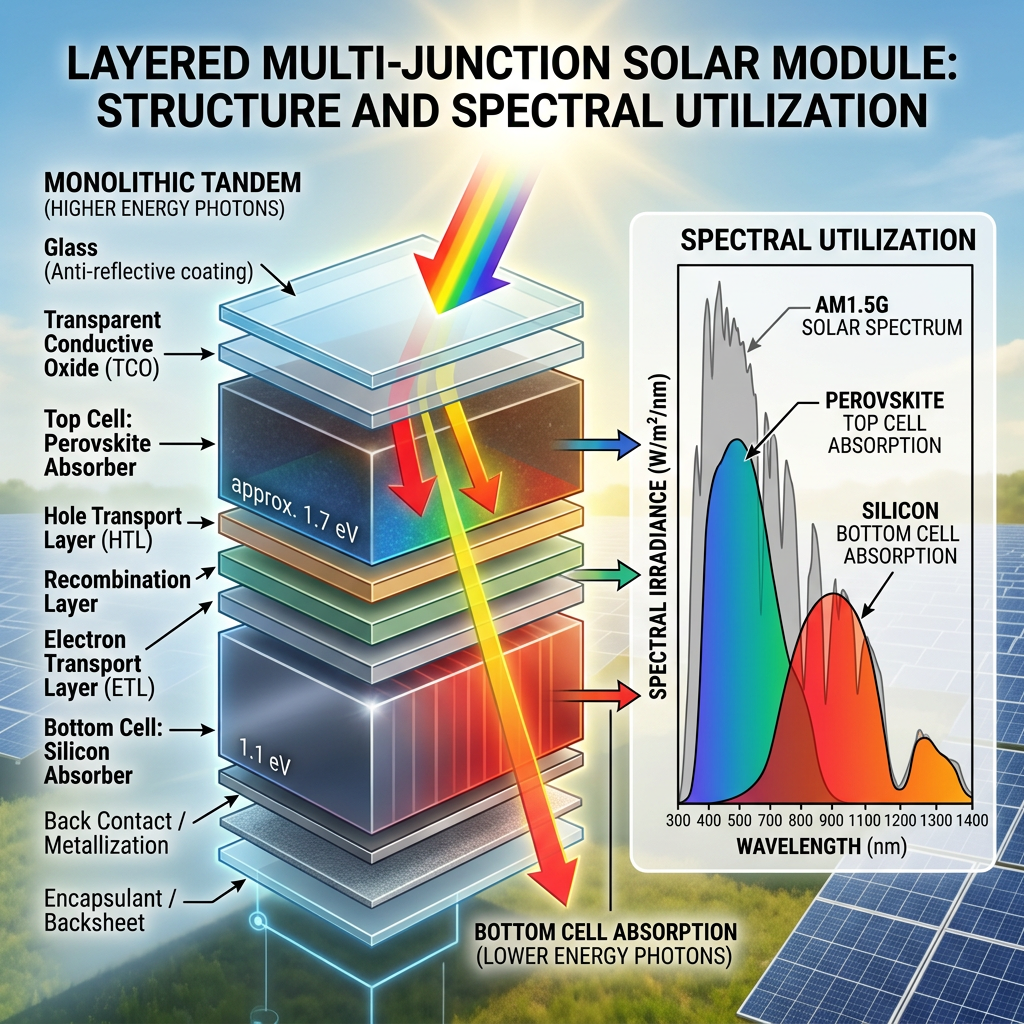
Diagram explaining the structure and spectral use of a layered multi-junction solar module.

As the solar industry pushes beyond the efficiency limits of conventional silicon photovoltaics, perovskite-silicon tandem cells are emerging as one of the most promising next-generation technologies. While traditional silicon modules dominate the market today, tandem architectures are attracting significant attention for their ability to surpass the performance ceiling of single-junction solar cells.

The principle behind tandem technology lies in optimizing how sunlight is converted into electricity. Conventional silicon cells can efficiently absorb only a portion of the solar spectrum, with excess energy often lost as heat. Tandem cells address this limitation by stacking two photovoltaic materials with different bandgaps. A perovskite top cell captures high-energy photons from the blue and green regions of the spectrum, while the silicon bottom cell absorbs lower-energy red and infrared wavelengths that pass through the upper layer.

This layered approach enables more effective utilization of solar radiation and significantly reduces energy losses associated with conventional cell designs. As a result, perovskite-silicon tandem cells have already demonstrated efficiencies exceeding 33% in laboratory settings, compared to approximately 26–27% for the most advanced silicon-only cells.

The industry is primarily focusing on two-terminal tandem architectures, which integrate both cells into a single electrical circuit while remaining compatible with existing module manufacturing processes. Researchers are also advancing interconnection layers, transparent conductive materials, and light-management techniques to further enhance performance.

Despite impressive efficiency gains, commercialization challenges remain. Long-term stability, moisture resistance, thermal durability, and large-scale manufacturing consistency continue to be key areas of development. However, with multiple companies advancing pilot production and pre-commercial deployments, tandem technology is steadily progressing toward market readiness.

If these technical hurdles are successfully addressed, perovskite-silicon tandem modules could redefine photovoltaic performance standards and drive the next major leap in solar energy generation.

For a foundational overview of the technology, read SolarQuarter’s earlier explainer: The Future is Layered: How Tandem and Perovskite Solar Cells Are Redefining Photovoltaics


Subscribe to get the latest posts sent to your email.

 

  • Related Posts

    CG Power Reports Record Q1 FY27 Revenue and Profit as Order Book Surges 45% to INR 17,333 Crore

    CG Power and Industrial Solutions Limited (CG) has reported record first-quarter financial performance for FY2026-27, with its highest-ever Q1 revenue and profit before tax (PBT) driven by strong execution across…

    LONGi Partners with Innoptus and Delft Solar Teams for 2026 American Solar Challenge

    Solar technology company LONGi has partnered with Belgium’s Innoptus Solar Team and the Netherlands’ Delft Solar Team for the 2026 Elektrek American Solar Challenge (ASC), expanding its efforts to validate…

    Have You Seen?

    Most Gulf Coast Refineries Unaffected by Tropical Storm Bertha

    • July 25, 2026
    Most Gulf Coast Refineries Unaffected by Tropical Storm Bertha

    CG Power Reports Record Q1 FY27 Revenue and Profit as Order Book Surges 45% to INR 17,333 Crore

    • July 25, 2026
    CG Power Reports Record Q1 FY27 Revenue and Profit as Order Book Surges 45% to INR 17,333 Crore

    US Energy Firms Cut Rigs for First Time in Six Weeks, Says Baker Hughes

    • July 25, 2026
    US Energy Firms Cut Rigs for First Time in Six Weeks, Says Baker Hughes

    Oil Falls on Report China Pushing for End US-Iran War

    • July 25, 2026
    Oil Falls on Report China Pushing for End US-Iran War

    PERSPECTIVE: Wind and Solar Have an Important Role – But They Are Energy “Diversification”, Not Energy “Transition”

    • July 25, 2026
    PERSPECTIVE: Wind and Solar Have an Important Role – But They Are Energy “Diversification”, Not Energy “Transition”

    Devon Energy Mulls $4 Billion Sale of Eagle Ford, Powder River Assets, Bloomberg News Reports

    • July 25, 2026
    Devon Energy Mulls $4 Billion Sale of Eagle Ford, Powder River Assets, Bloomberg News Reports

    LONGi Partners with Innoptus and Delft Solar Teams for 2026 American Solar Challenge

    • July 25, 2026
    LONGi Partners with Innoptus and Delft Solar Teams for 2026 American Solar Challenge

    Adani Power Reports Record Q1 FY27 EBITDA as Revenue Rises 28%, Advances 45 GW Capacity Expansion

    • July 25, 2026
    Adani Power Reports Record Q1 FY27 EBITDA as Revenue Rises 28%, Advances 45 GW Capacity Expansion

    Actis Secures IFC, Proparco Investment for Ulug Enerji Grid Upgrades

    • July 25, 2026
    Actis Secures IFC, Proparco Investment for Ulug Enerji Grid Upgrades

    Global LNG Giants Target Cambodia as New Energy Market

    • July 24, 2026
    Global LNG Giants Target Cambodia as New Energy Market