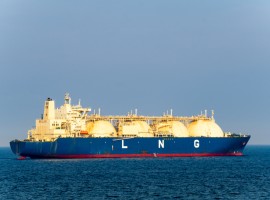
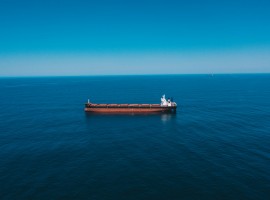
The Istanbul Bridge, carrying 25,000 tonnes of cargo containers, left China’s Ningbo port on 23 September, entering the Northern Sea Route on 1 October. The complete journey took 20 days, which Rosatom says is half the time of using traditional southern sea routes.
According to China’s official Xinhua news agency the journey time compares with the 25 days by rail via the China-Europe Railway Express, 40 days via the Suez Canal and about 50 days via the Cape of Good Hope. It said its cargo mainly comprised goods such as lithium-ion batteries and photovoltaic products “as the sea and temperature conditions along the route are well-suited for heat-sensitive and time-critical cargo”. Captain Zhong Desheng told Xinhua it was “exhilarating” and said preparations for using the new route began three years ago.
Vladimir Panov, Special Representative for Arctic Development at Rosatom, said: “The Northern Sea Route is developing rapidly, becoming a viable and efficient global logistics route. This is facilitated by various factors, including the development of advanced technologies, the construction of new-generation nuclear icebreakers, and growing interest from international shippers. Along with the main priority of ensuring the safety of navigation on the Northern Sea Route, managing the speed and time of passage along the route is becoming an important task for us today.”
This was the first transit voyage from China to Europe using the 5,600-kilometer Northern Sea Route, whose development Russia sees as a strategic priority.
The day after the vessel arrived in the UK at Felixstowe, the second meeting of the Russian-Chinese Subcommittee on Cooperation on the Northern Sea Route was held, chaired by Rosatom Director General Alexei Likhachev.

(Image: Rosatom)
At the meeting, an action plan was approved, “aimed at creating a sustainable transport corridor. Cooperation entails the implementation of modern logistics and technological solutions to improve transportation efficiency and develop capital projects”.
Likhachev said: “I am confident that the decisions made today will give further impetus to Russian-Chinese cooperation in developing the Northern Sea Route’s potential and will enable us to translate these cooperation opportunities into major capital projects. Our cooperation allows us not only to diversify global trade routes but also to implement advanced technologies in the development of challenging northern latitudes.”
Background
Nuclear-powered icebreakers are a key part of Russia’s plan to develop the Northern Sea Route, the shipping lane along its north coast, which runs between St Petersburg and Kaliningrad and Vladivostok. Russia says the distance is halved compared with using the Suez Canal.
Last year saw a record of nearly 38 million tonnes of cargo and Likhachev said in April that the potential was in the hundreds of millions of tonnes, with the current icebreaker fleet of 11 – including 8 nuclear-powered ones – needing to be increased to 17 in the coming years.
There are currently a series of Project 22220 nuclear-powered icebreakers operating – the Arktika, Sibir and Ural – or under construction – the Yakutia, Chukotka and Leningrad. Later this year the Stalingrad will be laid down.
The Project 22220 vessels are 173 metres long, 34 metres wide and with a height from the waterline to the mainmast of 57 metres. They are designed to break through ice up to three metres thick and have a speed of 22 knots in clear water. They are powered by RITM-200 reactors, a pressurised water reactor with a thermal capacity of 175 MW, which converts to 30 MW at the propellers. It is 7.3 metres high with a diameter of 3.3 metres and an integral layout which its manufacturers say means it is lighter, more compact and 25 MW more powerful than previous generations used on nuclear-powered icebreakers. The service life is 40 years.
There is also a larger nuclear-powered icebreaker under construction, the Rossiya, which will be the first of the proposed Project 10510 nuclear-powered icebreakers. It will feature two RITM-400 reactors for a propeller power of 120 MW. It will be able to penetrate ice up to 4.3 metres thick and clear a channel up to 50 metres wide. Its most recent reported construction target service date is 2030.