The UK Atomic Energy Authority (UKAEA) is decommissioning the Joint European Torus (JET), which ended plasma science operations in December 2023 after 40 years as the world-leading fusion facility.
It says that through “the characterisation and analysis of materials including beryllium, tungsten and Inconel” JET “continues its 40-year legacy of world-leading research and development, informing and enabling a sustainable fusion energy sector”.
The tiles and other components that were carefully removed using the remote handling robotic technology (see picture above) in late 2024, are being studied to “assess the key physical, chemical and radiological properties of the materials”.
As well as helping in the development of the decommissioning plan they “are also giving an initial indication of the impact of years of high-powered plasmas on plasma-facing components”.
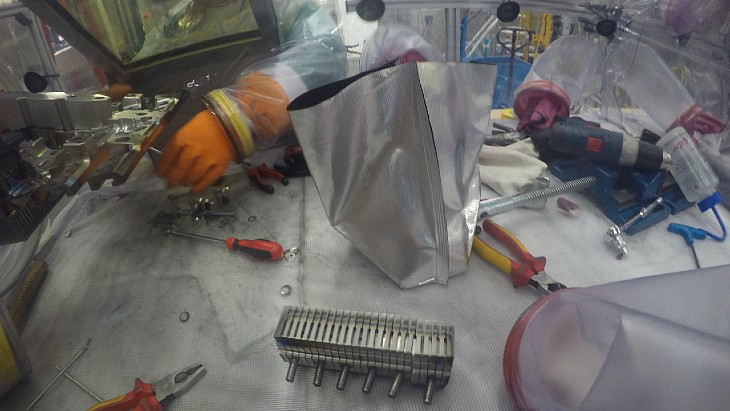
The findings will help inform future fusion plant designs (Image: UKAEA)
Towards the end of JET’s operation, UKAEA said, deliberate efforts were made to see “the impact of damage mechanisms – this included multiple intentional plasma disruptions and the associated electromagnetic forces, and aiming electrons at JET’s inner wall. By purposely creating these conditions, they were able to see surface melting and the reverse waterfall effect, providing unique insights that will assist in mitigating these issues in future fusion machines”.
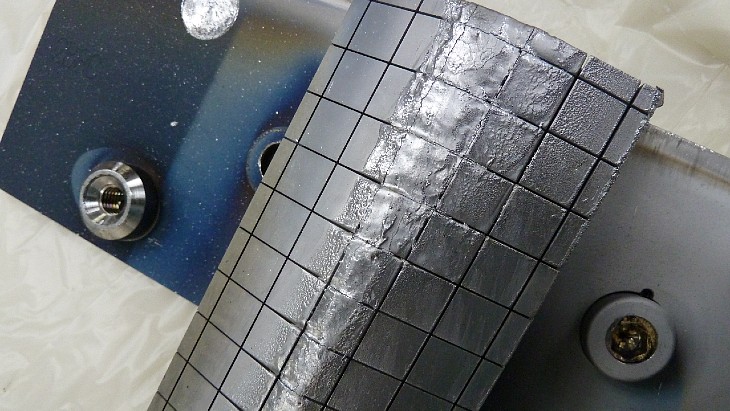
Some of the intentional damage being studied (Image: UKAEA)
Lewis Simmons, Lead Waste Engineer, JET Decommissioning and Repurposing at UKAEA, said: “The sample retrieval programme removed some of our most interesting and complex materials and undertaking experiments or analysis on these materials gives an indication of what the rest of the tokamak system will look like. It gives us a good opportunity to benchmark all of our predictive models, and to plan for full-scale decommissioning.”
As well as collaborating with EUROfusion to carry out Laser Induced Breakdown Spectroscopy experiments, UKAEA also developed and implemented Laser Induced Desorption with Quadruple Mass Spectrometry, a method of measuring the adsorption of tritium and other elements onto tiles and components inside the JET vessel using high-powered lasers.
Yevhen Zayachuk, Plasma Materials Surface Scientist, UKAEA, said those techniques “will allow us to monitor in real-time, or near-real-time, the dynamics of accumulation of fuel within the material of the wall. The studies of samples removed from the JET vessel will be used in order to support the development of these techniques”.
What is JET?
JET was a tokamak fusion system with a doughnut-shaped vacuum chamber where, under the influence of extreme heat and pressure, gaseous hydrogen fuel becomes a plasma. The charged particles of the plasma can be shaped and controlled by massive magnetic coils placed around the vessel to confine the hot plasma away from the vessel walls. It was the only tokamak fusion machine in operation capable of handling tritium fuel, and was a key device in preparations for the multinational ITER fusion research project which is currently under construction in southern France.
JET was a European project built and used collaboratively by European researchers. It is now owned, and in its last years operated by, the UKAEA, and used by scientists from 28 European countries to conduct research into the potential for carbon-free fusion energy in the future through work coordinated by the EUROfusion consortium. The tokamak’s first deuterium-tritium experiments took place in 1997.
JET’s final experiments using deuterium and tritium fuel were conducted over seven weeks from August to October 2023, ahead of its retirement following its final pulse in December. During those experiments, JET produced the largest amount of energy achieved in a fusion experiment, breaking its own record set in 2021. Following its retirement JET has moved on to repurposing and decommissioning, a process expected to last until about 2040, and which is seen as further opportunities to discover and develop new technologies and skills for future fusion.