Thursday, 20 February 2025
_81516.jpg)
At the Fukushima Daiichi site, contaminated water – in part used to cool melted nuclear fuel – is treated by the Advanced Liquid Processing System (ALPS), which removes most of the radioactive contamination, with the exception of tritium. This treated water is currently stored in tanks on site.
Japan announced in April 2021 it planned to discharge ALPS-treated water into the sea over a period of about 30 years. It started to discharge the water in August 2023 and has so far completed the release of ten batches, a total of 78,285 cubic metres of water.
The International Atomic Energy Agency (IAEA) has been monitoring the discharges of treated water and the collection of seawater samples since they began. In September last year, Japan and China reached an agreement that allows stakeholders, including China, to conduct independent sampling, monitoring and inter-laboratory comparisons at key stages of the discharge process.
On 19 February, Grossi joined scientists from the Third Institute of Oceanography in China, the Korean Institute for Nuclear Safety in South Korea and the Spiez Laboratory in Switzerland, along with IAEA experts, as they collected seawater samples near the Fukushima Daiichi plant.
“By welcoming countries to engage directly in sampling and analysis under the additional measures, Japan is increasing transparency, understanding, and trust, particularly in the region,” Grossi said. “Through these efforts, third parties can independently verify that water discharge levels are, and will continue to be, in strict compliance and consistent with international safety standards.”
The samples will be analysed by the IAEA laboratories in Monaco, by laboratories in Japan and in the participating laboratories from China, South Korea and Switzerland, each members of the IAEA’s Analytical Laboratories for the Measurement of Environmental Radioactivity network.
“Additional measures focus on expanding international participation and transparency, allowing hands-on independent measurements of the concentration level of the water,” Grossi said. “This work is conducted within agreed parameters set by the IAEA in its role as an independent, impartial and technical organisation.”
The IAEA has confirmed that the tritium level in the ten batches of ALPS treated water already released was far below Japan’s operational limit of 1500 Bq/litre. The IAEA says it will have a presence on site for as long as the treated water is released.
Grossi also visited the Interim Storage Facility (ISF) where removed soil arising from decontamination activities is stored and also observed a road embankment demonstration project for managed recycling, which is one of the measures to reduce the volume of removed soil towards its final disposal outside Fukushima Prefecture. The ISF was built to manage and store removed soil, waste arising from decontamination activities in Fukushima Prefecture, safely and in an integrated manner, until final disposal outside Fukushima Prefecture within 30 years from the start of transportation to the ISF.
The previous day, 18 February, Grossi visited Tokyo Electric Power Company’s (Tepco’s) Kashiwazaki-Kariwa nuclear power plant in Niigata Prefecture. During the visit, he saw safety equipment such as seawalls, emergency vehicles, and air-cooled gas turbine generators, as well as some of the security measures.
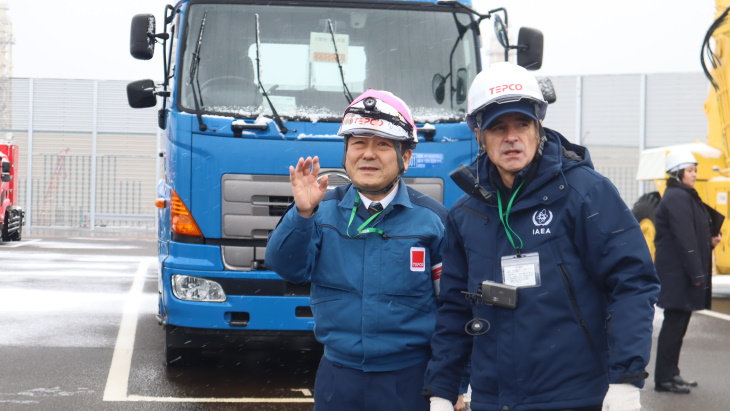
Grossi inspecting emergency vehicles at Kashiwazaki-Kariwa (Image: Tepco)
He said: “I have reviewed the management and monitoring system for security and access at the power plant, and I am very satisfied with the results. All measures have been taken over the past 15 years, and I am convinced that there is a certain basis for restarting the plant.
“The restart of this power plant is symbolic, and at the same time, it can be said that it will have a visible impact on Japan’s energy environment.”
In 2017, Tepco received permission from the Nuclear Regulation Authority (NRA) to restart units 6 and 7 at the plant. However, in early 2021, the company notified the NRA of malfunctions in intruder detection equipment on the Kashiwazaki-Kariwa site. In addition, it reported the unauthorised use of an ID card. In April 2021, the NRA issued an administrative order to Tepco prohibiting it from moving nuclear fuel at the plant until improvements in security measures there have been confirmed by additional inspections. This order was lifted in December 2023 after inspections confirmed that measures had been enhanced at the site.
Additional regulatory inspections will still be required before Kashiwazaki-Kariwa 7 – which has been offline since August 2011 – can resume operation. In addition, consent must also be sought from the local governor.