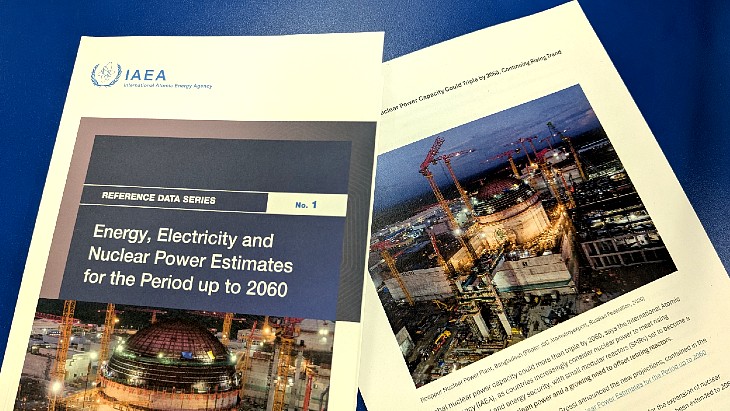
In , the International Atomic Energy Agency (IAEA) raises its projections of the growth of future nuclear energy capacity for the sixth successive year, with it now forecast to more than triple by 2060.
At the end of 2025, there were 413 operable nuclear power reactors operating worldwide, generating 377.1 GWe, the IAEA said. In its high-case scenario, the agency projects that this figure could reach 1,045 GWe by 2050 GWe – up from the 992 GWe forecast last year. This year’s projections continue to 2060 for the first time, with the nuclear generating capacity now reaching 1,284 GWe by that time, which would be 3.4 times the figure at the end of 2025.
The low-case projection for 2060 is for nuclear capacity to reach 696 GWe by 2060, and 641 GWe by 2050, up from the 561 GWe by 2050 forecast last year.
The publication, which is put together by an international group of experts, develops its estimates by considering all operating reactors, possible licence renewals, planned shutdowns and plausible and planned construction projects foreseen for the next few decades. The low-case assumptions are that current trends continue and there are few changes in laws, policies and regulations. The high-case assumptions include national intentions for expanding the use of nuclear power and the “high-case projection remains both plausible and technically feasible and notes the possibility for capacity to exceed this estimate”.
Enabling factors, such as national policies, supporting investment and workforce development – plus regulatory collaboration and global harmonisation – would be necessary to help facilitate at least reaching the high case.
IAEA Director General Rafael Mariano Grossi, speaking at the 70th IAEA General Conference in Vienna, said: “The IAEA projections show the increasing role of nuclear power in meeting the world’s growing electricity needs. To realise this potential, investment in new nuclear capacity and reactor lifetime extensions will be essential.”
The role of small modular reactors – the first few of which are now online or under construction – is projected to grow rapidly, to encompass 28% of the 1,017 GWe of new capacity added under the high-case projection, or 23% of the 521 GWe that would be added under the low-case.
The IAEA’s definition of a small modular reactor is for a capacity of up to 300 MWe, and the 100+ designs in development have a wide range of capacities, from a starting point of 20 MWe. Assuming an average capacity of 300 MWe, the low-case projects SMRs accounting for 120 GWe by 2060, which would be the equivalent of 400 new units. If those units averaged 250 MWe capacity it would mean 480 SMRs. Last year’s forecast to 2050 had a 24% share for SMRs in the high case and 5% in the low case.
The IAEA projections – which are to 2060, rather than 2050 for the first time – include a breakdown of SMR deployments across regions, projecting that about 60% of new nuclear capacity in North America could come from SMRs. In South-Eastern Asia and in Latin America and the Caribbean, the figure is 40% in both the high and low cases.
Also key to achieving the projected growth of future nuclear capacity is extending the life of currently operating reactors, with the IAEA Energy Planner/Economist Jessica Callen-Kovtunova telling a media briefing that under the high-case scenario 70% of currently operating capacity remains in operation in 2060, while under the low-case scenario that proportion is reversed, with almost two-thirds of currently operating units retired.
The IAEA says that “a lifetime extension for an existing reactor, if it is viable, is one of the most cost-effective baseload low emission electricity sources and is of particular importance for regions with ageing nuclear fleets”.
The role of finance is also seen as playing a big role. The document says: “The upward revision of the projections reflects growing recognition of the role that nuclear power can play in supporting energy security and long-term economic growth. There has been renewed engagement with nuclear power by international financial institutions, such as the World Bank Group and the Asian Development Bank, signalling a broader shift that other international financial institutions have begun to follow.
“Energy security and affordability concerns intensified following successive energy crises since 2022. Disruptions to oil and gas flows have major implications for both energy security and global energy markets. In response, interest in diversified electricity generation has grown, including interest in nuclear power.”
The IAEA also reported that compared with 2024, nuclear electricity generation increased by 1%, although global electricity generation grew faster, by 2.7%, with nuclear’s share of electricity generation falling from 8.7% in 2024 to 8.4% in 2025.
World Nuclear Association’s World Nuclear Outlook Report, published last week, found that if all national targets and goals were achieved and the existing fleet continues to operate.