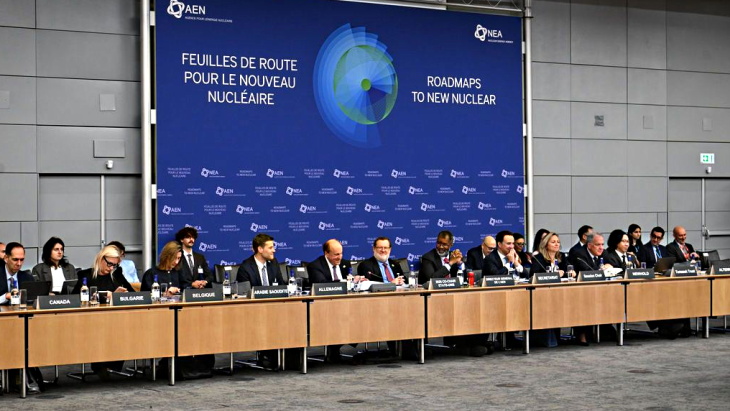
The OECD Nuclear Energy Agency (NEA) and the US Department of Energy co-hosted the 4th Roadmaps to New Nuclear conference in Paris, France, on 17-18 September. This annual event brings together government and industry leaders to address the most pressing issues for delivering new nuclear energy construction at the scale and pace required to meet the growing global expectations for nuclear energy.
In the opening session, Mathias Cormann, Secretary-General of the Organisation for Economic Co-operation and Development (OECD) said: “Today we are at the start of a nuclear resurgence. Almost 80 GW of new nuclear capacity is under construction across 15 countries, including emerging economies, from Egypt to Türkiye. That is equal to a fifth of today’s global capacity. In the United States, five new advanced reactors reached criticality this summer alone and the United States aims to quadruple its nuclear capacity by 2050 and 38 countries now support tripling global nuclear capacity by 2050. This new commitment to nuclear power comes not a moment too soon. The disruption in the Strait of Hormuz – a chokepoint for a quarter of the world’s seaborne oil trade – and the war in Ukraine have both shown why we need stronger energy security and a diverse energy mix … but this is not just about energy security. It is also about growing energy needs. Electricity demand in advanced economies is rising again after nearly 15 years of stagnation.”
Delivering new nuclear capacity at scale presents significant challenges, the NEA says, including workforce development, supply chain readiness, financing, fuel supply security, regulatory preparedness and project delivery. Roadmaps to New Nuclear 2026 aimed to focus on addressing these challenges, sharing recent experiences and identifying practical solutions.
In a press conference during the event, NEA Director-General William Magwood said: “The world has changed. The world has turned to nuclear energy as a big part of the solution to the energy security challenge of the future, and now we are moving from discussion and planning into implementation – that’s really the phase we are moving into now. There are challenges, but we are here now to discuss them and face them and to deal with them as quickly as possible so we can turn these ambitions to scale. The fuel for this is going to be important analysis and data, a common understanding about what it will take to bring nuclear to scale around the world.”
During the meeting, nine industry associations issued reaffirming their commitment to “advancing the peaceful uses of nuclear technology for the benefit of all humanity”.
The statement said: “Amid a shifting geopolitical environment and growing energy security concerns, we remain committed to: continuing operation of nuclear facilities in a safe and efficient manner; providing reliable, affordable, and resilient electricity and heat to strengthen industrial competitiveness and drive economic growth; and supporting the expansion of clean nuclear energy as countries seek greater energy security and independence and to meet their climate change goals.
“We encourage governments to take steps that enable greater use of nuclear energy including through nuclear plant life extensions, capacity uprates, restarts of nuclear plants, and deployment of new nuclear energy facilities in support of their economic, energy security and environmental objectives.”
According to the statement, governments need to take action to: pursue attribute-based, consistent long-term energy policies; safeguard energy security and resilience; facilitate access to finance; strengthen international regulatory cooperation; strengthen resilient and trusted nuclear supply chains; and build skills, industrial capability and innovation.
It concludes: “Nuclear energy can make an important and unique contribution to energy security, reliability, economic competitiveness, industrial capability and environmental performance. The nuclear industry therefore supports an attribute-based, predictable and durable policy environment in which nuclear energy can compete fairly and be valued for its full contribution to the energy system and wider economy. International cooperation should strengthen regulatory efficiency, access to finance, skills, innovation and resilient supply chains, enabling countries to deploy the nuclear technologies that best support their national priorities.”
The statement was signed by the heads of the Canadian Nuclear Association, GIFEN, Japan Atomic Industrial Forum, Korean Atomic Industrial Forum, Nuclear Energy Institute, Nuclear Industry Association, Nucleareurope and World Nuclear Association.
“Amid geopolitical uncertainty and growing energy security concerns, nuclear energy can support global economic growth, decarbonisation and the stability of our energy systems,” said Emmanuel Brutin, Director General of Brussels-based nuclear trade body Nucleareurope. “With our sister associations, we therefore call on governments to take steps to enable greater peaceful use of nuclear technologies through long-term operation of existing facilities and deployment of new nuclear capacity.”