By
29 min ago 3 min read
Carbon capture developer Mantel Capture is advancing its high-temperature carbon dioxide (CO2) capture technology towards commercial deployment, with projects underway at industrial facilities in Canada and the US and more than 100 projects in its commercial pipeline.
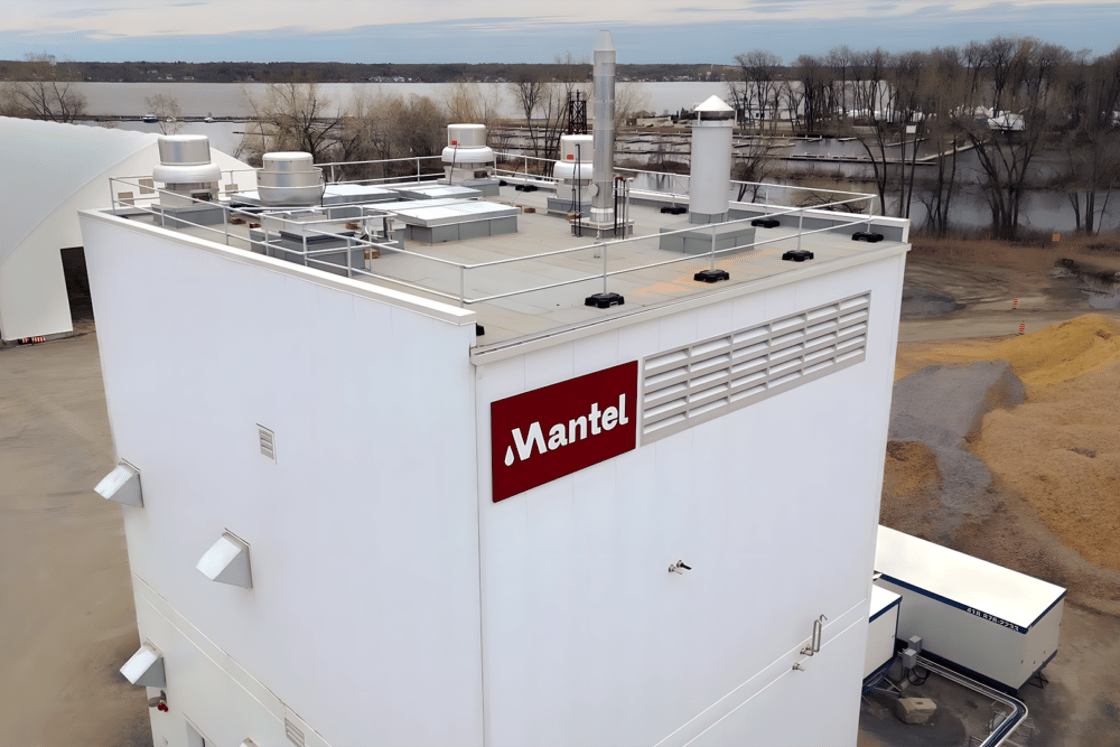
Mantel is demonstrating its technology at Kruger’s Wayagamack pulp and paper mill in Quebec, Canada, while developing projects with a Canadian oil and gas producer and a coal-fired power plant in West Virginia. The latter is supported by an $18.5m US Department of Energy award.
Mantel said its system can capture up to 98% of CO2 emissions while producing a CO2 stream with 99.9% purity, which could be sold for use in other applications.
The technology is designed to address a key challenge with conventional carbon capture, which requires energy to cool and reheat flue gases during the capture cycle.
Mantel instead uses a borate salt that is solid at room temperature but becomes liquid at the high temperatures found in industrial equipment such as boilers, kilns, furnaces and gas turbines.
The molten salt captures CO2 from hot flue gas before the captured gas is released during a subsequent heating stage. Mantel says the process can also recover heat as high-pressure steam, which can be used to generate electricity or fed back into industrial operations.
The liquid-phase approach is intended to overcome degradation seen in solid sorbents, which can lose performance as they are repeatedly heated and cooled.
“The interaction between the sorbent material and the CO2 needs to be strong, so you can capture it well, but not so strong that you can’t get it back off,” said Cameron Halliday, CEO of Mantel.
Mantel said its sorbent showed no measurable performance decline over 1,000 cycles, avoiding the structural changes and cracking that can affect solid capture materials because it remains liquid at operating temperatures.
Mantel has built a shipping-container-sized version of its capture system, which MIT said had been operating for two years. Its demonstration at Kruger is designed to test the technology under commercial operating conditions.
Mantel said its commercial pipeline includes more than 100 opportunities across refineries, data centres, cement, steel and oil and gas.
The company says its system is designed to integrate with existing industrial facilities with little or no modification, particularly where steam and heat are already central to operations.
Mantel’s recent $18m strategic investment from Constellation Technology Ventures and Azimut Investments brings its total funding to $50m and is intended to support commercial deployment across North America, Europe and other markets.
In July, Mantel entered a strategic supply agreement with Aalborg CSP to develop modular designs for its molten-salt systems, with the aim of reducing construction complexity and enabling components to be manufactured off-site and assembled at industrial facilities.
Halliday said the long-term ambition is for carbon capture to become a standard addition to industrial plants, in much the same way as equipment for removing other pollutants from flue gases is now routinely incorporated into facilities.
“We need to be deploying these carbon capture technologies, particularly through Asia and Africa, because that’s where the people are. That is where the industry is, increasingly,” he added.