Wednesday, 7 May 2025
_48469.jpg)
Each 4-metre-tall, 110-tonne cylindrical module is wound from about 6 kilometres of niobium-tin superconducting cable and requires more than two years of precision fabrication and verification. The final phase, in-factory testing, verifies performance by simulating conditions that the module will experience during operation at ITER.
US ITER and supplier General Atomics have announced the completion of testing of the sixth module at the General Atomics Magnet Technologies Center in Poway, California.
The sixth production module, which is the last module required to complete the central solenoid stack, was subjected to a series of demanding tests including helium leak testing, high voltage insulation testing, cooldown to 4.5 K and charging to 48.5 kA followed by a series of tests designed to measure as-built performance of the superconductor.
Four central solenoid modules have already been delivered by US ITER and stacked on a dedicated assembly platform at the construction site in Cadarache, France. The fifth module is en route and the sixth will be shipped in the coming months.
Fabrication of a seventh module, which is to be used as a spare, remains to be finalised.
US ITER has also delivered the ‘exoskeleton’ support structure that will enable the central solenoid to withstand the extreme forces it will generate. The exoskeleton is comprised of more than 9000 individual parts, manufactured by eight US suppliers.
ITER’s magnetic system consists of toroidal and poloidal magnetic field coils, correction coils, and the central solenoid. This is the largest superconducting system ever created. The fully assembled pulsed magnetic system will weigh almost 3000 tonnes.
Thirty-three nations are collaborating to build ITER – the European Union is contributing almost half of the cost of its construction, while the other six members (China, India, Japan, South Korea, Russia and the USA) are contributing equally to the rest. Construction began in 2010 and the original 2018 first plasma target date was put back to 2025 by the ITER council in 2016. However, in June last year, a revamped project plan was announced which aims for “a scientifically and technically robust initial phase of operations, including deuterium-deuterium fusion operation in 2035 followed by full magnetic energy and plasma current operation”.
In addition to supplying the superconductor, Russia has manufactured and sent one of the six poloidal magnetic field coils – the PF1 coil – to the construction site.
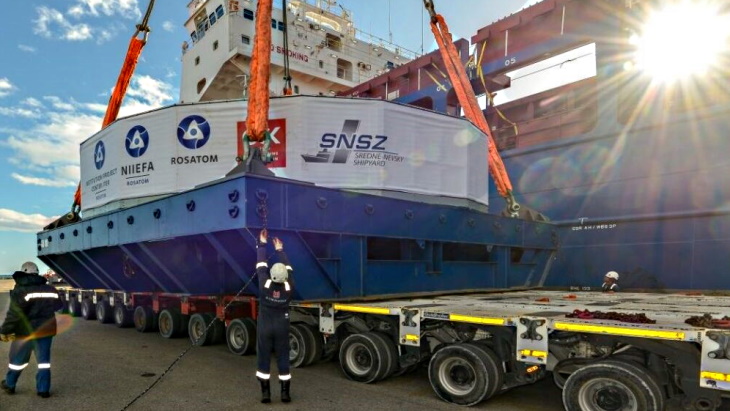
The PF1 coil (Image: Rosatom)
“The magnetic system, the most complex and powerful ever created, is the basis, the foundation of the entire future installation – without it, the operation of ITER is basically impossible,” said Anatoly Krasilnikov, Director of the ITER Project Center (a Rosatom institution).
“Through joint efforts with international partners, we have successfully completed this stage, and this is our common, collective merit. Russia, our enterprises, took direct part in this process. We produced 120 tonnes of niobium-titanium superconductor (by the way, in close cooperation with Europe), as well as more than 17 km of niobium-tin superconductor.”