Mars in 30 days? Russia unveils prototype of plasma rocket engine

Friday, 7 February 2025
Mars in 30 days? Russia unveils prototype of plasma rocket engine
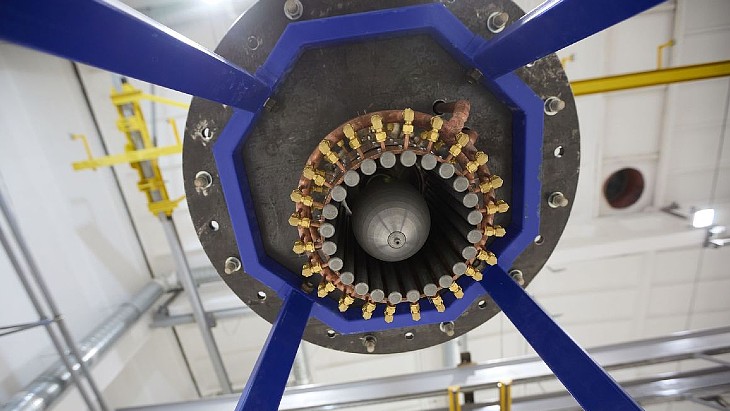
(Image: Rosatom)

Rosatom says that the average power of the engine, operating in pulse-periodic mode, reaches 300kW making it possible to accelerate the spacecraft to much higher speeds than conventional engines.

Alexey Voronov, first deputy director general for science at the Rosatom Research Institute in Troitsk, said: “Currently, a flight to Mars using conventional engines can take almost a year one way, which is dangerous for astronauts due to cosmic radiation and exposure to radiation. Using plasma engines can shorten the mission to 30-60 days, meaning it will be possible to send an astronaut to Mars and back.”

He said that creating a prototype was “one of the most important stages of the project” as it seeks to determine whether it will be suitable for spacecraft, and to get an idea on the costs of their production.

A large-scale experimental stand is being assembled to test the prototype, featuring a 14-metre-long/4-metre-diameter vacuum chamber to simulate the conditions of outer space for the tests.

Mars is about 140 million miles from Earth. To cover that distance in 30 days would require an average speed of about 195,000 miles per hour. Other countries, including the European Space Agency and the USA have on-going projects relating to cutting journey times and conditions that will make it possible for astronauts to travel to Mars and back.

According to Russia’s Izvestia newspaper the engine thrust will be about 6N and researchers say “the propulsion system will be able to accelerate particles (charged electrons and protons) to a speed of 100 km/s. This will allow spacecraft to make interplanetary flights and even go beyond the solar system”.

It describes a plasma rocket motor as “a type of electric motor. It is based on two electrodes. Charged particles are passed between them, and at the same time a high voltage is applied to the electrodes. As a result, the current creates a magnetic field that pushes the particles out of the engine”. It adds that the launch into orbit would be using traditional methods, and the aim is that “the flight model of the unit will appear in 2030”.


   

  • Related Posts

    China and Russia sign nuclear-related MoUs during Xi-Putin talks

    Rosatom’s Alexei Likhachev, pictured above left, and China Atomic Energy Agency’s Shan Zhongde signed one on cooperation in developing human resources for the peaceful uses of nuclear energy. The agreement provides for…

    TerraPower and HD Hyundai sign Natrium reactor agreements

    As well as signing the framework agreement with HD Hyundai Heavy Industries making it TerraPower’s strategic manufacturing partner, a separate memorandum of understanding was agreed between Terrapower, HD Hyundai and Hyundai…

    Have You Seen?

    Inside the Unraveling of U.S. Diplomacy Under Trump

    • May 21, 2026
    Inside the Unraveling of U.S. Diplomacy Under Trump

    US Natural Gas Storage Capacity Rises in 2025, Says EIA

    • May 21, 2026
    US Natural Gas Storage Capacity Rises in 2025, Says EIA

    ConocoPhillips Says Venezuela’s Bid to Woo Oil Firms Falls Short

    • May 21, 2026
    ConocoPhillips Says Venezuela’s Bid to Woo Oil Firms Falls Short

    China Raises Fuel Price Caps Again as Iran War Keeps Oil Markets on Edge

    • May 21, 2026
    China Raises Fuel Price Caps Again as Iran War Keeps Oil Markets on Edge

    Saudi Oil Export Income Jumped to 3.5-Year High in March as Prices Soared

    • May 21, 2026
    Saudi Oil Export Income Jumped to 3.5-Year High in March as Prices Soared

    China Boosts Oil Stockpiles Despite Import Plunge

    • May 21, 2026
    China Boosts Oil Stockpiles Despite Import Plunge

    U.S. Energy Storage Installations Post Record First Quarter

    • May 21, 2026
    U.S. Energy Storage Installations Post Record First Quarter

    China’s Solar Exports Soar as World Grapples with Energy Crisis

    • May 21, 2026
    China’s Solar Exports Soar as World Grapples with Energy Crisis

    Japan’s Crude Imports from Middle East Slump to Lowest on Record

    • May 21, 2026
    Japan’s Crude Imports from Middle East Slump to Lowest on Record

    Texas Tech University wins $4.5m state grant for semiconductor development

    • May 21, 2026
    Texas Tech University wins $4.5m state grant for semiconductor development