Tokyo Electric Power Co (Tepco) said the investigation would take approximately two weeks and investigate the conditions inside the reactor as well as the access route for planned fuel debris retrieval, saying “we will continue to move forward safely and steadily with this task”.
Air tightness has to be maintained at all times – see Tepco diagram below for more details – and each of the two drones flew for about 8 minutes.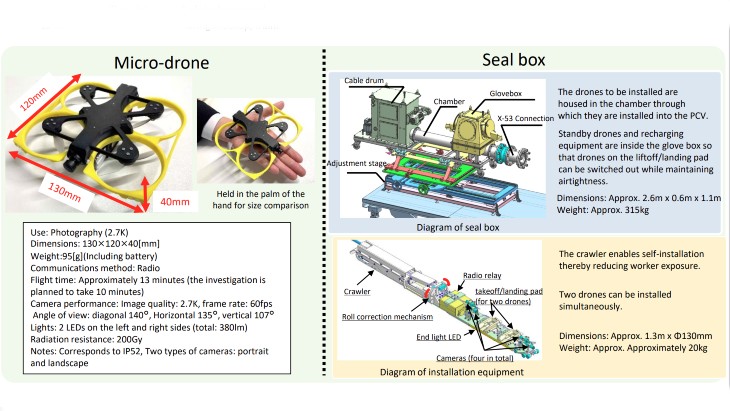
The drones used are 13 centimetres by 12 centimetres, weigh 95 grams including battery, and have cameras and LED lights.
According to the plans, there will be initial flights to determine the range of radio communications in new flight areas, followed by the next stage of flights to obtain footage and then flights for detailed investigations.
According to The Asahi Shimbun, the plan for the drones to make an entire circuit inside the vessel was shortened because of poor communications. It quoted Akira Ono, president of Fukushima Daiichi Decontamination & Decommissioning Engineering Co, as saying: “There may be mist reducing visibility at times. We will make safety our top priority when deciding whether to continue the investigation.”
Background
On 11 March 2011 a major earthquake struck Japan. It was followed by a 15-metre tsunami which disabled the power supply and cooling of three reactors at the Fukushima Daiichi nuclear power plant and all three cores largely melted in the first three days. In units 1 to 3, the fuel and the metal cladding that formed the outer jacket of the fuel rods melted during the accident, then re-solidified as fuel debris. Unit 4 does not contain any used fuel or fuel debris as it had already been defuelled before the accident.
There is an estimated total of 880 tonnes of fuel debris in units 1-3. To reduce the risk from this fuel debris, preparations are under way for retrieving it from the reactors.
Tepco succeeded in extracting small samples of fuel debris from the unit 2 reactor in November 2024 and in April 2025. It reportedly concluded after studying the specific removal method that it would take around 12 to 15 years just to prepare for the work. There is a fair amount of uncertainty about the distribution of fuel debris in each of the reactors and decommissioning process is expected to continue into the second half of the century.