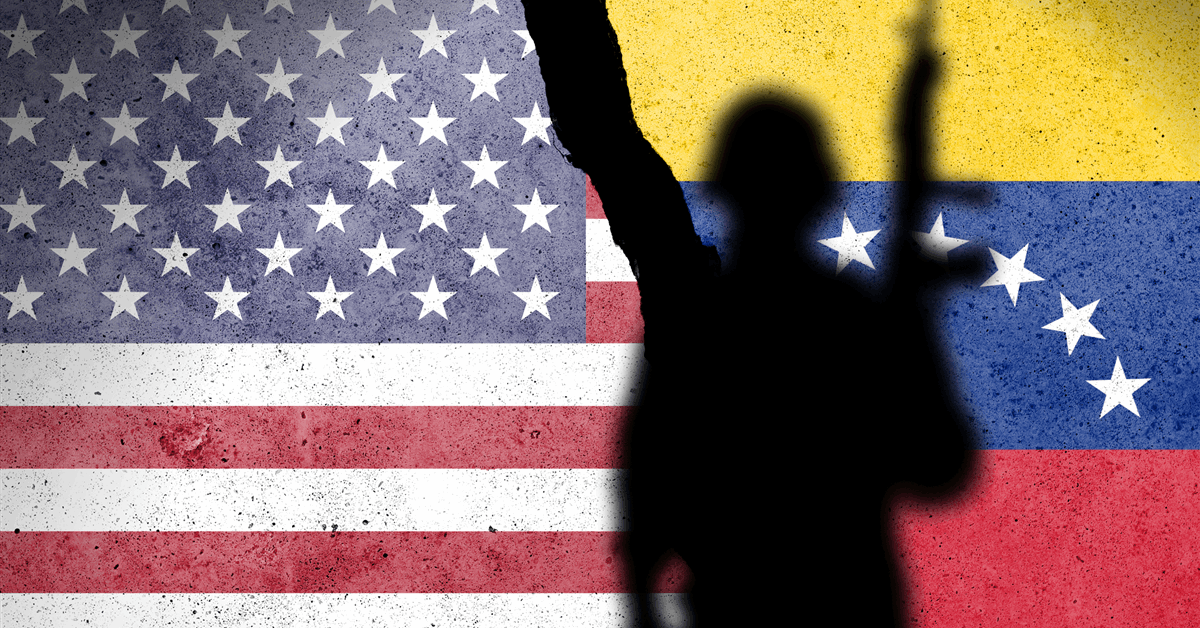
Benchmark crude oil prices could be impacted significantly by escalating military tensions between the U.S. and Venezuela, with the Trump administration tightening pressure on Nicolas Maduros’ regime and signaling the possibility of a U.S. incursion.
That’s what Rystad Energy stated in a market update sent to Rigzone by the Rystad Energy team late Thursday, adding that Venezuela currently produces 1.1 million barrels per day of crude oil, “placing this volume at risk depending on the scale of military activity”.
“Although the volume is small in terms of global trade flows, the quality is unique as over 67 percent of the output is heavy,” Rystad highlighted in the update.
Rystad Energy’s Head of Geopolitical Analysis, Jorge Leon, noted in the update that “the loss of Venezuelan volumes would likely result in stronger crude oil prices in the Pacific Basin, with China and India dependent on the heavy supply”.
“Dubai prices are likely to develop stronger premiums to Brent crude while other heavy grades will strengthen against the light grades. Some upward movement in Brent and West Texas Intermediate (WTI) prices is also expected with the overall loss of Venezuelan supply,” he added.
Leon went on to warn in the update that volatility in the region is unlikely to subside in the immediate term.
“The geopolitical risk premium remains firmly embedded in oil markets, with upside price risks persisting as traders brace for possible setbacks or renewed escalation,” he said.
“Over the coming days and weeks, the balance between cautious optimism and entrenched uncertainty will continue to shape market sentiment,” he added.
In the update, Rystad highlighted that Venezuela “claims to have the largest proven reserves in the world, around 300 billion barrels as of 2024, concentrated in the Orinoco belt with most being heavy oil”.
The company noted in the update that its estimates point towards four billion barrels of proven and 23 billion barrels of discovered reserves.
“In any case, large reserves prompted significant investment historically from a number of countries: China, Russia, Iran, and the U.S. to name a few,” Rystad said in the update.
“Ultimately, irrespective of significant reserves, technical problems and underinvestment have resulted in steady declines in production since the early 2010s. At its peak, Venezuela was responsible for nearly three million barrels per day, but declines set in following a governmental change and nationalization of assets,” it added.
Rystad stated in the update that a trough was hit in 2020 when the total averaged 624,000 barrels per day.
“In addition to the output drop, most of Venezuela’s refining capacity is not operational as facilities have fallen into disrepair,” Rystad said.
“While many domestic refining facilities have stopped operating, the PDVSA (The Petróleos de Venezuela, S.A) does own and operate several locations internationally,” it added.
Rystad highlighted in the update that, in 2024, Venezuela produced 975,000 barrels per day of crude oil, of which 657,000 barrels per day was heavy.
“Light and medium crude oil production averaged 116,000 and 201,000 barrels per day, respectively,” the update noted.
“Venezuela’s production was approximately one percent of global supply but 4.5 percent of global heavy crude oil supply in 2024. This year is expected to be a peak year, topping out at 1.11 million barrels per day. Production is expected to decline slowly to 901,000 barrels per day by the end of 2030,” it added.
“Of this, the vast majority has historically been exported to either the U.S., China, Spain, or India. Pre-2020, the split of crude oil exports was relatively even between these four countries. As of 2025, however, U.S. sanctions have forced exports to be diverted to China, which in 3Q25 was the destination for 81 percent of Venezuelan exports,” it continued.
Rigzone has contacted the White House, the Consular Section of Venezuela in the United Kingdom and Ireland, the State Council of the People’s Republic of China and the International Press Center of China’s Ministry of Foreign Affairs, and India’s Ministry of External Affairs for comment on Rystad’s update. At the time of writing, none of the above have responded to Rigzone.
In a report sent to Rigzone by the Standard Chartered team last week, Standard Chartered Bank Energy Research Head Emily Ashford stated that, “in the event of a regime change in Venezuela”, Standard Chartered Bank “would expect a short-term reduction in oil to the market, tightening the heavy-sour market, before any lifting of sanctions led to the resumption of legitimate sales”.
“Venezuelan oil production has taken a precipitous slide from 2017 onwards, with a slew of sanctions prohibiting its access to financial markets. Production has slowly risen from its September 2020 low of 360,000 barrels per day, heading back towards one million barrels per day, supported by black-market sales,” Ashford added.
The Energy Research Head went on to state that “a long-term and full recovery in Venezuela’s oil exports to the 2.5 million barrels per day it sustained over 2011-2015 will be a multi-year process”.
Rigzone has contacted the White House and the Consular Section of Venezuela in the United Kingdom and Ireland for comment on the Standard Chartered report. At the time of writing, neither have responded to this Rigzone request.
To contact the author, email