In January, the Ontario government formally asked Ontario Power Generation (OPG) to explore opportunities for new nuclear energy generation at the Wesleyville site, near Port Hope, following expressions of interest from the Municipality of Port Hope and the Williams Treaties First Nations.
The Discovery Centre, described by OPG as a new hub for learning, exploration, and community engagement related to potential new nuclear generation at the Wesleyville site, will serve as a venue for community members and Indigenous Nations to access up-to-date information, participate in activities, and share their feedback, the company said.
At an opening ceremony held on 10 October, Ontario Minister of Energy and Mines Stephen Lecce described the centre as a “significant step forward” for Ontario’s clean energy future. “This nation-building project represents our sense of ambition and plan for self-reliance by creating 10,500 jobs and adding CAD235 billion to the Canadian economy. This project and new Centre will be the frontline for learning, jobs, and economic growth as we lead the largest nuclear expansion on the continent,” he said.
New nuclear capacity – both small modular reactors and large-capacity plants – is a key part of the strategy launched by Lecce in June, which aims to ensure Ontario – which already gets more than half of its electricity from nuclear plants – has the affordable, secure, reliable and clean energy it needs. The province is supporting the development and deployment of small modular reactor units at OPG’s Darlington site, and pre-development work has already begun to site the first large-scale nuclear build in the province since 1993 at the existing Bruce nuclear site. This is in addition to the ongoing refurbishments of Ontario’s existing nuclear power plants, extending their operating periods by a further 30-35 years each.
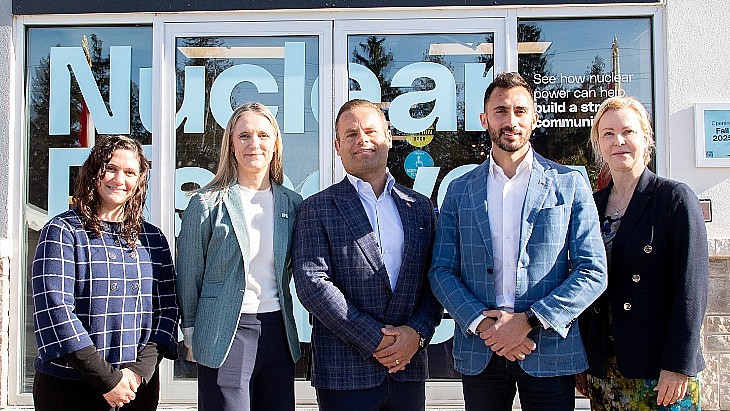
Lauritsen (second from left) and Lecce (second from right) pictured at the opening of the new centre (Image: Stephen Lecce)
The 1,300 acres (more than 5 square kilometres) Wesleyville site covers is located near existing transmission, road, and railway infrastructure, and is already zoned for new electricity generation. Early assessments by OPG have suggested the site could host up to 10,000 MW of new nuclear generation – which the company says would make it the largest nuclear generating station in the world. The site has been maintained by OPG for more than 50 years, specifically for the purpose of hosting new electricity generation.
According to information from OPG, Wesleyville was prioritised for site work over two other potential locations at Lambton and Nanticoke because the First Nations and the municipality have expressed interest in exploring nuclear generation development there, although discussions with the two other communities are still continuing.
Several years of work by OPG, in collaboration with the host community and Indigenous Nations, will be needed before it can be determined whether the Wesleyville site can proceed to support new power generation. Regulatory and licensing actions would then need to be completed before site preparations could begin. According to OPG, it could take around 15 years before the first generating unit is connected to the grid: a potential development roadmap shared by the company envisages units entering service in the early to mid 2040s.
“OPG is committed to building strong, collaborative partnerships with both the local community and the Michi Saagiig First Nations,” said Kim Lauritsen, SVP Enterprise Strategy & Growth. “The Nuclear Discovery Centre will act as a welcoming space for information-sharing, meaningful participation, and open dialogue that guides the project’s progress.”