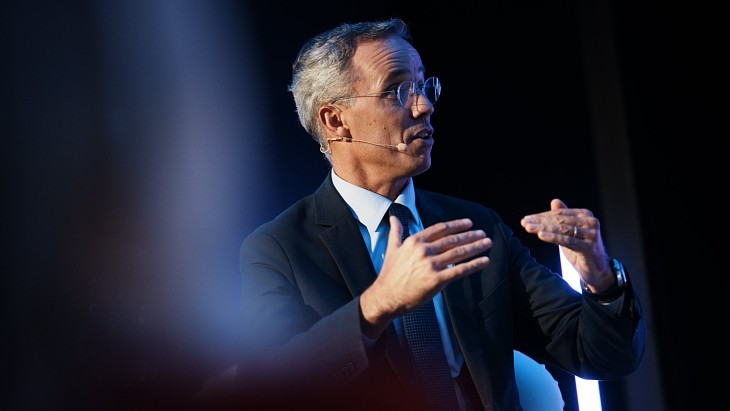
Maes said that demand for nuclear fuel has been increasing, as nuclear capacity has increased. But he said that there was a 10-year period between a utility making a decision on new capacity and them using Orano products. This means that at the moment “we are seeing some growth, but what we are focusing on is to be ready to face the further growth we are anticipating, and the tripling”, he said.
This has involved modernising and renewing existing facilities as well as increasing enrichment capacity in France, and plans in the USA.
“For the longer term, we are renewing and planning the replacement of our reprocessing and recycling facility for spent fuel. I don’t think anybody is that concerned about the uranium mining industry in the short term … but when you go into the very long term, past ‘peak uranium’ – which is not tomorrow – there will be something to be done,” he said.
“Now all of the major players are addressing it,” he said, referencing Russia, China and the US as well as France. “The world nuclear industry needs it for the long run, not for this decade, not for the next decade. You can start building your reactors, but for the very long term … we’re preparing.”
Reprocessing of used nuclear fuel and its reuse as fuel in reactors and advanced reactors helps to reduce the need for uranium while also reducing waste.
Maes also said that, while he welcomed the positivity about nuclear energy, “the enthusiasm must not lead people to lose focus on nuclear safety”. He said there were a lot of newcomers to the industry and some of the timelines being promised “are not compatible with the time it takes to get a nuclear safety culture – we must make sure that the paramount decision maker is not dollars, but safety, for authorities, investors, everybody”.
“It doesn’t mean we can’t innovate, it doesn’t mean that we can’t meet deadlines,” he said, praising China and the UAE. He also said some standardisation of fuel for new generations and various designs of reactors was something being discussed in France, so that supply chains can be built and then expanded as necessary to meet new demand.
Earlier, in a separate session,Vincent Berger, High Commissioner on Atomic Energy, France, talked about the country’s plans to expand its nuclear capacity, firstly via long-term operation programmes for its existing reactors, as well as the fleet of new EPR2s that are currently planned over the coming decade-and-a-half.
He also stressed the importance of regulation for achieving new nuclear goals. He said that the experience with the EPR reactors in Finland, China, France and the UK was that they were first-of-a-kind in each country they have been built. This adds a lot of time and cost, he said.
With small modular reactors (SMRs) the hope is to avoid such problems, he said, noting that with large reactors each country had its own histories and rules and regulations, but for SMRs “the history is not written yet”. He said with different countries all agreeing on the safety requirements, collaboration between different regulators could hopefully start to build some common rules between countries.