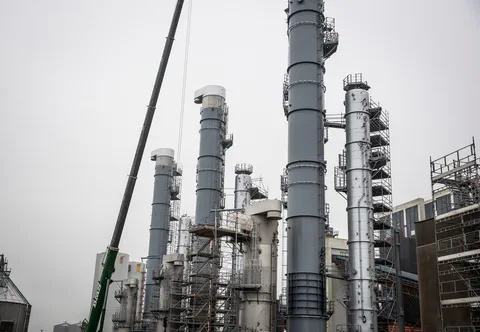
Absorbers, desorbers, and direct contact coolers—crucial components for future carbon capture facilities at Asnæs Power Station and Avedøre Power Station—have now been successfully installed. This achievement marks a significant milestone for the ‘Ørsted Kalundborg CO2 Hub’ and keeps the project on track. With this progress, Denmark’s first carbon capture and storage (CCS) value chain is moving closer to becoming a reality.
Ørsted has taken the next big step towards the realisation of Denmark’s first full-scale carbon capture and storage project (CCS), the ‘Ørsted Kalundborg CO2 Hub’. This is done with the lifting five sets of absorbers, desorbers, and direct contact coolers, which together constitute the key components of the two carbon capture facilities under construction. Three sets have been lifted into place at Asnæs Power Station, two sets at Avedøre Power Station.
Ole Thomsen, Senior Vice President and Head of Bioenergy at Ørsted, highlights the installation of key components as a major step in Denmark’s CCS journey. He emphasizes that the absorbers, desorbers, and direct contact coolers are essential for CO2 capture and storage, marking significant progress toward the project’s realization.
Installation of internals and piping for the key components is now underway, integrating them with the rest of the power stations. Meanwhile, Ørsted has received CO2 tanks for temporary storage of captured carbon dioxide, which will be transported to the Northern Lights storage reservoir in the Norwegian North Sea once the ‘Ørsted Kalundborg CO2 Hub’ becomes operational.
The ‘Ørsted Kalundborg CO2 Hub’, which was awarded a 20-year contract by the Danish Energy Agency in May 2023, will capture 430,000 tonnes of biogenic CO2 annually from the two combined heat and power plants. The capture and storage of carbon from the straw- and woodchip-fired power stations remove CO2 from the atmosphere. The ‘Ørsted Kalundborg CO2 Hub’ is expected to be operational in early 2026.
Facts – how the key components work:
The sets are comprised of three components that each performs a key role in capturing carbon dioxide:
1. Direct contact cooler (DCC): Cools the flue gas by spraying water directly into it. Removes impurities and reduces the temperature, which improves the efficiency of the carbon capture.
2. Absorber: Removes carbon dioxide from the flue gas by passing it through a liquid that chemically binds the carbon dioxide. The carbon dioxide-rich liquid is then sent to the desorber for further processing.
3. Desorber: Heats the carbon dioxide-rich liquid to release the carbon dioxide gas. The released carbon dioxide is collected and compressed for storage or further use.
Each carbon capture unit will be able to capture 12,5 tonnes of carbon dioxide per hour.
Facts about the ‘Ørsted Kalundborg CO2 Hub’ project:
- The ‘Ørsted Kalundborg CO2 Hub’ project aims to capture and store 430,000 tonnes of carbon dioxide annually from early 2026, equivalent to the annual carbon emissions from approximately 200,000 petrol-powered cars.
- Ørsted is responsible for the full CCS value chain.
- Ørsted will capture 150,000 tonnes of biogenic carbon per year from the straw-fired unit at Avedøre Power Station. The carbon dioxide will initially be transported by lorry to Asnæs Power Station until a potential shared pipeline infrastructure across Zealand has been established.
- The straw-fired unit at Avedøre Power Station converts locally sourced straw into electricity and district heating. The straw used is a by-product of agriculture.
- Ørsted will capture 280,000 tonnes of biogenic carbon per year from the wood chip-fired unit at Asnæs Power Station, which will also function as a carbon dioxide hub, handling and shipping biogenic carbon from both the Avedøre and Asnæs power stations to the Northern Lights storage reservoir in the Norwegian part of the North Sea.
- The wood chip-fired unit at Asnæs Power Station converts wood chips into electricity, district heating, and process steam for the local industry. The wood chips come from sustainably managed production forests and consist of surplus wood from forest management and sawmills.