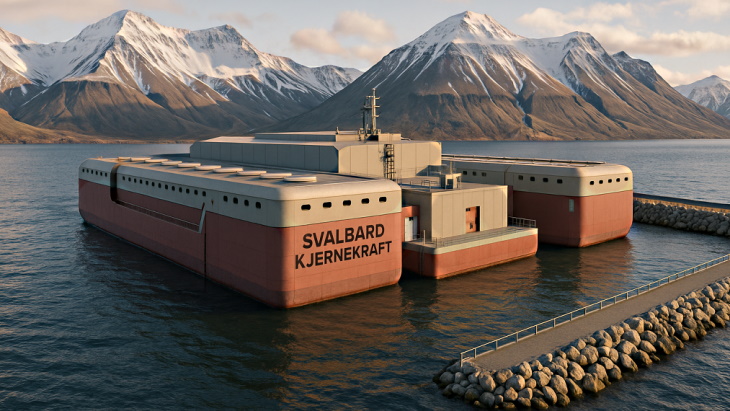
In June this year, Swedish lead-cooled SMR technology developer Blykalla and Norwegian nuclear project developer Norsk Kjernekraft announced the launched of a joint project company, Svalbard Kjernekraft AS.
Longyearbyen – the administrative centre of the Svalbard archipelago – was powered by coal until 2023. Since the closure of the coal plant, temporary diesel systems have been installed, resulting in higher costs and reduced reliability. Blykalla and Norsk Kjernekraft aim to build a compact SMR that connects to the existing electricity and district heating grid, effectively replacing the old coal infrastructure.
Svalbard Kjernekraft has now submitted a planning initiative for a SEALER (Swedish Advanced Lead Reactor) lead-cooled SMR in Longyearbyen. The report describes the project, local conditions and suggests topics for further investigation. The list of topics includes, among others, the environment and biodiversity, safety, waste management, ripple effects for society and effects on local businesses and jobs. The final location for the nuclear power plant will be determined through the impact assessment.
“With the planning initiative submitted, the next stage is for the Governor of Svalbard to set the scope of the environmental impact assessment,” Blykalla said. “Once that is in place, detailed studies and stakeholder consultations can begin, paving the way for the licensing process and eventual construction.”
“We are proud that this Swedish technology can deliver stable, emissions-free power to Svalbard,” said Blykalla co-founder and CTO Janne Wallenius. “Our lead-cooled reactors are ideal for this kind of remote application.”
The company said the Longyearbyen project will “also serve as a showcase for how advanced SMR technology can help secure energy supply in places with limited energy capacity, both in the Nordics and around the world”.
Norsk Kjernekraft CEO Jonny Hesthammer added: “This collaboration marks a new chapter in Norway’s history as a polar nation. Reliable and affordable energy is a prerequisite for Norway’s continued assertion of sovereignty in Svalbard, especially given the current geopolitical situation. Now that the coal-fired power plant in Longyearbyen has been closed, nuclear power is the only long-term solution to maintain energy security without using fossil fuels.”
In February this year, a memorandum of understanding was signed between Blykalla and Norsk Kjernekraft to collaborate on the deployment of Blykalla’s SEALER in Scandinavia. Under the MoU, the two companies are to assess the business case for integrating the SEALER into power plant projects currently under development by Norsk Kjernekraft, evaluating site suitability, regulatory pathways, and economic feasibility for deployment in Norway. Additionally, the agreement outlines collaboration on licensing, financing, construction, and operational aspects of Blykalla’s first reactor, SEALER-One, in Sweden. The MoU also includes a commitment to explore the possibility of providing electricity to remote locations.
Blykalla – formerly called LeadCold – is a spin-off from the KTH Royal Institute of Technology in Stockholm, where lead-cooled reactor systems have been under development since 1996. The company – founded in 2013 as a joint stock company – is developing the SEALER SMR.
SEALER-One is Blykalla’s first nuclear reactor and commercial venture. It will function as a demonstration of its technology, and at the same time be used for pyrolysis, whereby industrial customers can utilise its steam for, among other things, decarbonised biochar production. The company aims to achieve criticality of SEALER-One by 2029.