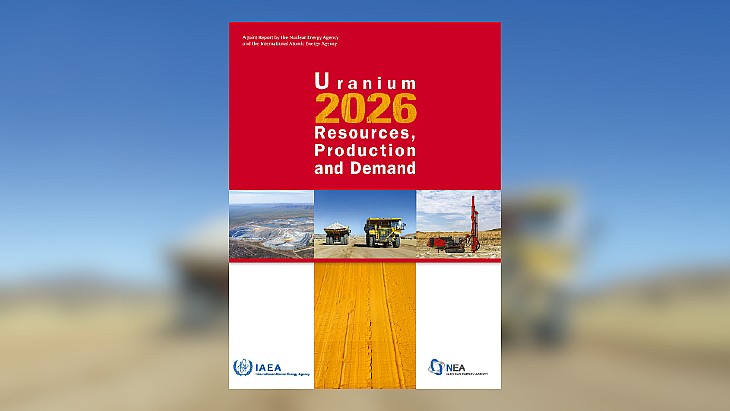
Uranium 2026: Resources, Production and Demand (commonly known as the ‘Red Book’) published jointly by the OECD Nuclear Energy Agency (NEA) and the International Atomic Energy Agency (IAEA) is the 31st report in a series dating back more than 60 years and is based mostly on government-provided data. Launched during the 70th IAEA General Conference in Vienna, the report covers the years 2023 and 2024, as well as including some information from 2025 and 2026.
As of 1 January 2025, currently identified uranium resources recoverable at costs below USD260/kgU were more than 8.1 million tonnes of uranium (tU) globally – up 2.1% from the figure reported in the previous edition, published in 2025. Expenditure in uranium exploration and mine development – essential to sustain future demand – has increased significantly in recent years, reaching USD1.8 billion globally in 2023-2024 – a 46% increase in exploration from the 2021-2022 period. According to Adrienne Hanly, Lead, Uranium Resources and Production at the IAEA, this is a response to the signal that more uranium will be needed to supply future nuclear growth.
Global nuclear generating capacity is projected to increase substantially by 2050: the Red Book cites growth scenarios under which uranium demand could more than double by 2050 in a high-demand scenario and increase by 42% in a low-demand case. The level of identified uranium resources is sufficient to meet even the highest projected uranium demand through 2050, the report concludes – but notes that resource availability alone does not guarantee supply security. Converting resources into production will require “timely, substantial and sustained investment” – and given the long lead times associated with uranium mining project development, identifying and advancing new projects in the near to medium term is crucial to avoid potential supply disruptions. And this will need the right signals – “adequate and sustained uranium prices supported by long-term contracts” are critical to maintain exploration momentum, support final investment decisions for new mines, and accelerate innovation in extraction techniques for improved processing and recovery of resources, it concludes.
The report finds that global uranium production increased by around 20% in 2023 and 2024 compared with the previous two years, reaching more than 116,000 tU: 2024’s production alone (61,924 tU) was the highest since 2006. This upward trend – driven primarily by the restart of previously idled capacity and the expansion of output at existing mines, particularly in Canada – is expected to continue in the near and medium term.
Speaking at the launch event in Vienna, World Nuclear Association Director General Sama Bilbao y León said: “The renewed momentum in uranium mining reflects the growing recognition that nuclear energy will need to play a larger role in the future clean energy systems of the world. It is a story of confidence – confidence that nuclear energy will continue to expand, confidence that the fuel cycle can evolve to meet that growth, and confidence that industry, governments and international organisations can continue to work together to ensure the secure supply of the fuel that underpins abundant, affordable, clean, reliable nuclear energy.”
The 2026 Red Book is available .