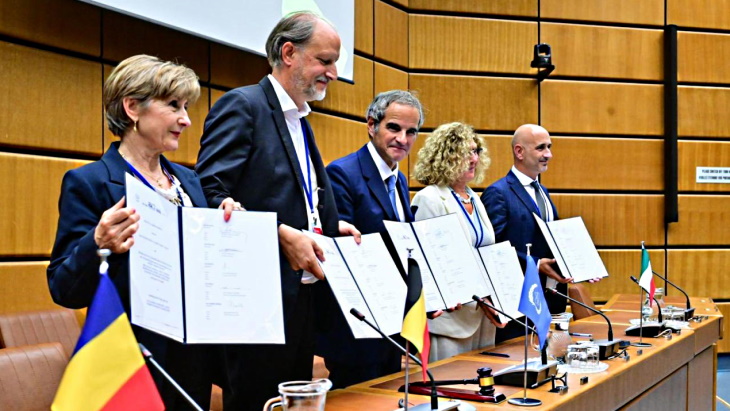
Four European nuclear technology organisations launched the Eagles Consortium in June this year to develop and commercialise the EAGLES-300 SMR with the aim of delivering a first demonstration by 2035. The agreement was signed by Belgium’s SCK-CEN nuclear research centre, Italy’s national agency for new technologies, energy and sustainable economic development ENEA, Italian company Ansaldo Nucleare, and Romanian state-owned nuclear R&D coordination organisation RATEN.
EAGLES-300 is a lead-cooled Generation IV small modular reactor. Last year, the design – then referred to as the EU-SMR-LFR – was one of two lead-cooled fast reactor proposals selected by the European Industrial Alliance on Small Modular Reactors, a European Commission initiative to facilitate and accelerate the development, demonstration, and deployment of the first SMR projects in Europe in the early 2030s.
Key features of EAGLES-300 will include high power output and grid flexibility, with around 300 MWe power, also suitable for industrial heat supply and hydrogen production; modular design, for lower construction investment, faster construction and flexible deployment; and optimised fuel management, using mixed-oxide (MOX) nuclear fuel, including recycled materials, reducing radioactive waste and enhancing sustainability.
During a signing ceremony held on 15 September on the sidelines of the IAEA’s General Conference in Vienna, the Eagles Consortium and Belgium’s Federal Agency for Nuclear Control (FANC), Italy’s National Inspectorate for Nuclear Safety and Radiation Protection (ISIN) and Romania’s National Commission for Nuclear Activities Control (CNCAN) officially launched an international pre-licensing initiative for the EAGLES-300 reactor.
Pre-licensing is a structured, exploratory process that allows nuclear regulators and technology developers to engage in early dialogue before a formal licensing application is submitted. For advanced technologies like lead-cooled SMRs, pre-licensing helps identify potential issues early and supports a more efficient, better-informed licensing process later on.
The EAGLES-300 pre-licensing project is a first-of-a-kind initiative: “Never before have national regulators collaborated so early in the development process of an advanced SMR”, consortium members said. By aligning safety standards and regulatory expectations early, while fully respecting national responsibilities, the EAGLES pre-licensing project aims to reduce duplication, clarify requirements, and accelerate the safe worldwide deployment of advanced SMRs.
The IAEA supports the project within its Nuclear Harmonisation and Standardisation Initiative (NHSI) Regulatory Track. NHSI aims to align regulatory practices across borders, making it easier to license and deploy innovative reactor designs like EAGLES-300 efficiently and safely. Through this coordinated effort, the consortium said it is already laying the groundwork for the future of advanced nuclear energy.
“Our support of this pre-licensing joint review effort is a natural next step of the IAEA’s Nuclear Harmonisation and Standardisation Initiative, which is helping to ensure SMRs move from development to deployment in a safe and timely way,” said IAEA Director General Rafael Mariano Grossi. “Almost every day the IAEA gets inquiries about when SMRs will be available. From developing countries looking to power growing electricity grids to technology companies needing electricity for AI data centres, the need for low-carbon, reliable nuclear energy in the form of SMRs is there and the IAEA is at the centre of the international effort to make sure this demand can be met, with due consideration for safety, security and safeguards.”
The Eagles Consortium plans to leverage two test facilities on its route to commercialisation. The LEANDREA technology demonstrator, at Mol in Belgium – which the consortium aims to deliver by 2035 – will focus on fuel and materials testing; while the ALFRED (Advanced Lead Fast Reactor European Demonstrator) project, at Pitești, Romania, will be upgraded to serve as a stepping stone toward commercial deployment. With global commercialisation for EAGLES-300 targeted in 2039, the consortium said it is adopting a stepwise approach to development, ensuring technical feasibility and economic viability at each stage.
“We are technically and scientifically on track. With our two key test facilities, LEANDREA and ALFRED, we will work step by step towards the commercialisation of the EAGLES-300 in 2039 and its broad rollout,” the Eagles Consortium said. “Taking this pre-licensing step now is therefore a crucial milestone on the road towards commercialisation, just two months after our foundation.”