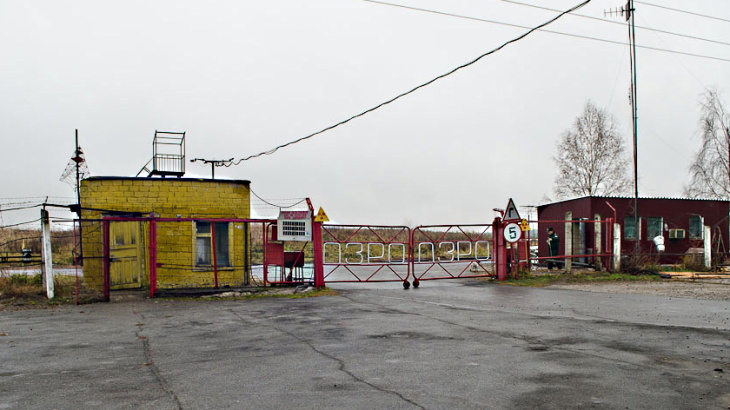
The Buriakivka RAW Disposal Facility is one of the key components of the system for managing the large volumes of accident-related radioactive waste generated as a result of the 1986 Chernobyl accident, established as part of the priority emergency response measures and commissioned in 1987 to store low- and intermediate-level radioactive waste originating from Chernobyl.
The facility – located within the Chernobyl Exclusion Zone – is operated by the SSE Central Enterprise for Radioactive Waste Management (CERWM), Ukraine’s sole operator of ryadioactive waste disposal facilities. During the period of operation of the facility, 31 surface disposal facilities (trench-type) – measuring 150 × 50 metres – for the disposal of radioactive waste have been filled. The main engineered barrier providing the radionuclide containment is a specially constructed 1-metre-thick clay shield. The last repository, No.21A, was commissioned in 2018 and was fully filled by the end of 2023. In total, since the start of operation, about 635,918 cubic metres of Chernobyl-origin radioactive waste has been emplaced in the Buriakivka trenches. Radioactively contaminated vehicles, which were used during mitigation of the Chernobyl disaster, are also stored at Buriakivka. In 2012, CERWM started dismantling and size-reduction of these vehicles.
To expand the capacity of the facility through the construction of a new (trench-type) repository, No.11A, CERWM agreed the working design for the construction of the repository, taking into account the results of the comprehensive state expert review of this project, and earlier this year submitted an application for a licence to carry out activities during the construction phase of the new repository.
The State Nuclear Regulatory Inspectorate of Ukraine (SNRIU), with the involvement of the State Scientific and Technical Center for Nuclear and Radiation Safety (SSTC NRS), conducted a state review of the nuclear and radiation safety of the Safety Analysis Report for the construction phase of the new repository to assess its compliance with the requirements of legislation, standards and regulations on nuclear and radiation safety.
At its meeting on Tuesday, the Board of SNRIU considered the results of the state expert review and approved its conclusion confirming the reasonableness of the design decisions taken and the safety of the designed repository, as well as the capability of CERWM to carry out activities during the construction phase of the repository in accordance with the established nuclear and radiation safety standards and regulations.
SNRIU recommended that CERWM ensures the updating of safety justifications during the construction phase of the repository, taking into account the actual implementation of design solutions, refined characteristics and radioactive waste streams, and to submit them as part of the Safety Analysis Report for the operational phase of the repository and other operational documentation required to subsequently obtain a licence for the operational phase of the repository.
The construction of the new near-surface repository, and subsequently its commissioning, will enable the continued disposal of low-level radioactive waste generated during the decommissioning of the Chernobyl plant, as well as from other entities operating in the field of nuclear energy, the regulator noted.