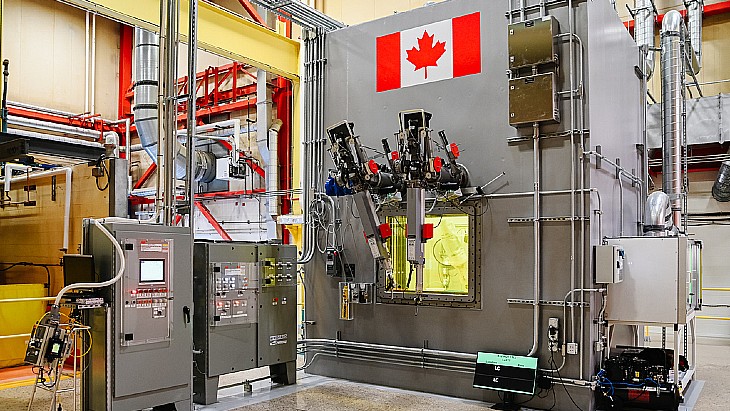
The Canadian Nuclear Safety Commission’s approval to operate the hot cell facility – construction of which was completed in July – is a significant milestone in Bruce Power’s production of cancer-fighting medical isotopes, the company said.
Lutetium-177 (Lu-177) is a medium-energy beta emitter which can be used in targeted therapy while helping minimise damage to surrounding, healthy tissue. It has a half-life of 6.7 days and is compatible with various targeting agents, ranging from short peptides to large biomolecules. As well as emitting beta particles, Lu-177 also emits low-energy gamma radiation. This makes it useful for theranostics: a precision medicine approach that integrates diagnostic and therapeutic methods, often using radiopharmaceuticals, to identify and treat diseases such as cancer.
Lu-177 can be made either directly, by irradiation of lutetium-176, or indirectly, by irradiation of ytterbium-176 (Yb-176) to produce the short-lived intermediate radioisotope ytterbium-177, which decays to Lu-177.
Most medical radioisotopes are made in a relatively small number of research reactors around the world, but the characteristics of Canada’s Candu pressurised heavy water reactors means they are particularly suited for producing medical radioisotopes as well as power generation. Bruce Power has been producing cobalt-60 – used to sterilise single-use medical devices – since 1986, and began producing medical-grade cobalt-60 for cancer treatments in 2021. In 2022, it became the first commercial nuclear operator to produce Lu-177 using an innovative Isotope Production System (IPS) installed in Bruce unit 7 to irradiate Yb-176 targets which are then sent for processing and distribution to health care facilities.
The new on-site hot cell facility is part of a broader isotope production expansion effort at Bruce Power, which also includes the installation of an additional IPS in Bruce unit 6. It was constructed through a Canadian collaboration involving Bruce Power, Kinectrics and Bird Construction and enables operators to safely handle irradiated materials remotely while minimising radiation exposure.
The CNSC’s approval means Bruce Power will now be able to use the facility to perform Target Carrier Removal, an important step in the Lu-177 production process. Bringing this capability on-site will further streamline isotope production, reduce transportation requirements, enhance worker safety, lower emissions and strengthen Ontario’s position as a global leader in medical isotope innovation, Bruce Power says.
“This approval represents another transformational step in Bruce Power’s journey to improve lives through the production of cancer-fighting medical isotopes,” Bruce Power Chief Operating Officer and Executive Vice-President James Scongack said. “With the hot cell now licensed and approved for operations, we are strengthening Ontario’s integrated isotope supply chain, increasing efficiency, and expanding our ability to deliver cancer-fighting medical isotopes to patients around the world. This achievement reflects years of innovation, collaboration and dedication from our employees, partners and regulators, and reinforces Canada’s position as a global leader in isotope production.”