A new report from the Institute for Energy Economics and Financial Analysis (IEEFA) says U.S. coal-fired power plants have as much as $6.5 billion of unused coal inventory, based on the latest figures on fuel stockpiles from the U.S. Energy Information Administration (EIA).
The said the nation’s coal-fired power stations today are burning only about 1 million tons of coal daily, half the amount the industry was using in 2015. The “days of burn,” or the amount of coal on hand divided by the amount being burned each day, for coal-fired power plants at present is about four months on average, according to the IEEFA. The group said most operators would usually keep a 50- to 60-day supply on hand. Government data shows coal-fired generation accounts for about 16% of U.S. electricity production, about half the share it held a decade ago.
The EIA said U.S. coal-fired power plants had about 138 million tons of coal on hand at the end of November. The IEEFA based its analysis on a $47.22 per ton average cost of coal delivered to U.S. power plants (including transportation) from January through September of this year.
‘Harder to Burn Coal Without Losing Money’
The IEEFA in its report said the 138 million tons of coal currently stockpiled is the same amount expected to be produced by basins in Appalachia next year.
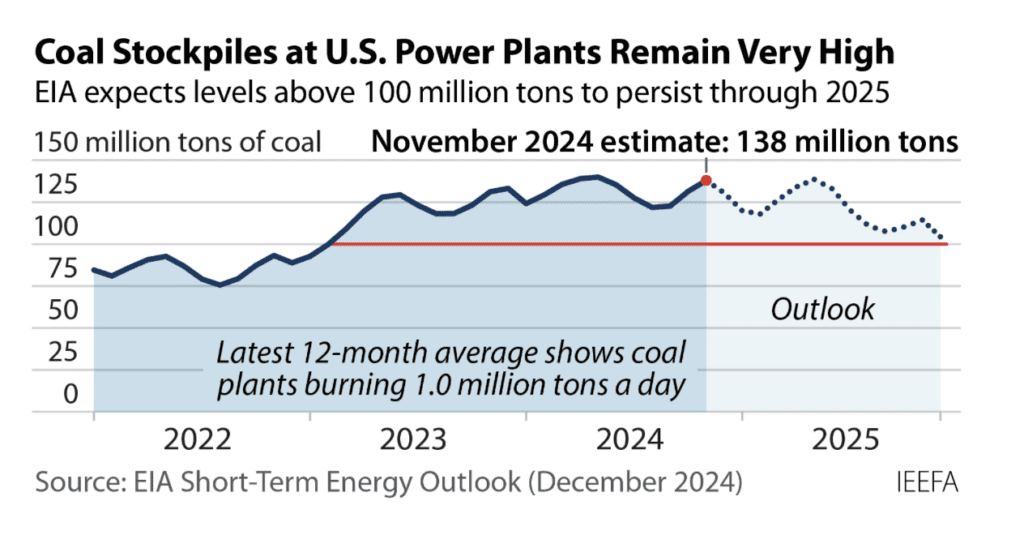
Seth Feaster and Dennis Wamsted, authors of the IEEFA report, wrote, “No power producer wants that much money idly sitting around. But it has become much harder to burn that coal without losing money. Low gas prices, as well as increased solar and wind generation, have made coal-fired electricity less and less competitive.
“Periods with high electricity prices during summer heat waves and winter cold snaps also have become fewer and farther apart. As a result, U.S. coal plants now collectively burn just 1 million tons a day, half as much as in 2015, based on the 12-month average through September. At that rate, it would take power producers more than 4 months to use up all the coal sitting around.”
The IEEFA report said that deliveries of coal to U.S. power plants “have already been falling steadily for more than 15 years, from more than 80 million tons a month in 2008 to about 30 million a month in 2024. With huge stockpiles at power plants that utilities need to use, that trend looks set to continue in 2025, and could lead to some months with less than 20 million tons in deliveries.”
Highest Stockpiles in Texas, Indiana
The EIA said that as of September 2024, coal-fired power plants in Texas had about 12.3 million tons of coal stockpiled, accounting for about 10% of the U.S. total. Indiana coal-fired plants ranked second in stockpiles, with about 8.8 million tons. State data shows there are 14 operating coal-fired power plants in Texas. There are 15 operating coal-fired stations in Indiana, according to state data.
The EIA in its report said its expects U.S. coal consumption will rise slightly next year. The agency forecasts a 1% increase, to 409 million short tons (MMst), from 2024, in line with the group’s expectation of a 1% increase in electric power consumption in 2025. That comes after coal consumption dropped by 5% from 2023 to this year.

The EIA said just 3 GW of coal-fired generation was retired this year, after 11 GW was shuttered in 2023. The agency said, though, it expects more retirements of coal-fired generation capacity—as much as 11 GW—in 2025, in part due to more renewable energy capacity coming online. The IEEFA said it expects as much as 13 GW of the remaining 173 GW of U.S. coal-fired generation will be retired or converted to natural gas next year.
The EIA in the December report said it expects 25 GW of solar power will enter service next year, along with 9 GW of wind energy capacity. The agency in its report said the “combination of a modest increase in consumption from operating coal plants and a decline in coal production will reduce coal inventories held by power plants from 131 MMst [million short tons] at the end of this year to 100 MMst by the end of 2025.”
Coal-to-Gas Conversions
Conversions of coal-fired power units to burn natural gas, a frequent occurrence over the past several years, are continuing. Appalachian Power, which serves customers in Virginia, West Virginia, and Tennessee, last week said it could convert two of its coal-burning plants in West Virginia—John Amos and Mountaineer—to burn natural gas, which would enable the power stations to keep operating rather than being shut down by 2032. The company said it has ruled out installing carbon capture and storage (CCS) technology at the plants.
“CCS has not been commercially demonstrated and is not expected to be developed in time to be a viable option,” wrote Robert Jessee, Appalachian Power’s vice president of generating assets, in a filing with state regulators. “Therefore, to comply with the [Environmental Protection Agency’s] GHG [greenhouse gas] rule the companies must either convert their existing coal-fired plants to gas or shut the plants down.”
Officials in Homer City, Pennsylvania, earlier this month said the 2-GW Homer City Generating Station, a three-unit coal-fired power plant that was closed last year, . A local official said the new gas-fired plant could have as much as 4 GW of generation capacity, which would make it the largest gas-fired power station in the U.S.
—Darrell Proctor is a senior editor for POWER.