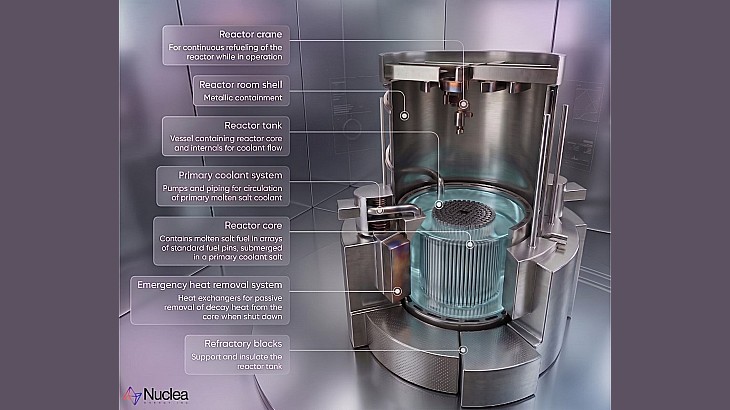
Molten salt reactors (MSRs) use molten fluoride salts as primary coolant, at low pressure. They may operate with epithermal or fast neutron spectrums, and with a variety of fuels. Much of the interest today in reviving the MSR concept relates to using thorium (to breed fissile uranium-233), where an initial source of fissile material such as plutonium-239 needs to be provided. There are a number of different MSR design concepts, and a number of interesting challenges in the commercialisation of many, especially with thorium.
The study by the UK’s University of Liverpool and Denmark’s Copenhagen Atomics – – shows that a high salt purity prevents corrosion of 316L stainless steel – a widely used, cost-effective material – in MSRs. This discovery paves the way for more affordable, durable, and scalable next-generation nuclear energy systems. The harsh, high-temperature environment of molten fluoride salts has historically caused rapid corrosion of structural materials, limiting their commercial viability. Previous solutions relied on expensive, high-nickel alloys, which drove up costs and complicated manufacturing.
The researchers conducted long-term corrosion tests on 316L stainless steel in both purified and untreated molten salts (FLiNaK and LiThF) at temperatures up to 700°C. The results indicated that untreated salts – containing moisture and oxides – caused severe corrosion, with metal loss, surface degradation, and structural weakening after just 1,000 hours. However, purified salts, with impurities removed, resulted in negligible corrosion even after 3,000 hours. The steel retained its integrity, with only a thin, protective chromium carbide layer forming on its surface.
“Salt purity is absolutely central to corrosion control in molten salt reactors,” said Maulik Patel, Professor of Nuclear Materials, University of Liverpool, who co-authored the study. “These results confirm what decades of research, including work at Oak Ridge during the MSRE era, have pointed toward: if you remove the reactive impurities, molten salts can become a stable and manageable environment for reactor materials. This is a major step forward for the field.”
Thomas Steenberg, co-founder and VP Critical Materials at Copenhagen Atomics, added: “Hopefully, this study will once and for all silence the ‘corrosion myth’ that MSR is unfeasible due to corrosion. Using engineering controls is highly preferable to the use of exotic unobtanium alloys.”
“While this study establishes a strong foundation, further research is needed to assess the impact of radiation, fission products, and dynamic reactor conditions on long-term material performance,” Copenhagen Atomics noted. “Optimising salt purification methods will also be essential to eliminate even trace impurities.”
Copenhagen Atomics is developing a containerised molten salt reactor. Moderated with unpressurised heavy water, the reactor consumes nuclear waste while breeding new fuel from thorium. Small enough to allow for mass manufacturing and assembly line production, the reactor has an output of 100 MWt.
Irradiation tests
Meanwhile, NRG-Pallas has announced that research into materials for MSRs has commenced at the High Flux Reactor (HFR) in Petten, the Netherlands. This irradiation research – being conducted as part of the NRG-Pallas research programme on behalf of the Ministry of Economic Affairs and Climate Policy – will examine the interaction between the salt and the construction materials of a future MSR.
_bfc4b887.jpg)
(Image: NRG-Pallas)
Since 2015, NRG-Pallas has been developing capabilities to qualify molten salt fuel and MSR construction materials (alloys, graphite, etc) for use in a high-temperature neutron field.
The HFR is one of the few material testing reactors in the world that can investigate nuclear fuels and achieve significant neutron damage in construction materials. The reactor is used for both the production of medical isotopes and for research into nuclear energy, and operates at full power for approximately 260 days per year, with intermittent stops for maintenance and fuel loading. A high neutron flux in combination with instrumentation enables accelerated testing of materials and fuels under controlled conditions. The HFR will be replaced by the new Pallas reactor, currently under construction in Petten, ensuring the continuity of these unique irradiation services for nuclear fuels and materials.
“The molten salt programme at NRG PALLAS includes research into suitable construction materials, the processing and purification of molten salts, and the stabilisation of radioactive waste,” said Arjan Vreeling, manager of nuclear irradiation at NRG-Pallas. “Several projects have already been completed within the programme. This irradiation is groundbreaking because the influence of irradiation on the corrosion of construction materials has not been tested before. Within a few years, we will be able to see how the material behaves.
“In addition, we are identifying which fission products are released from the fuel during irradiation. The fuel must remain as pure as possible during use, so it is important to know whether the fission products formed remain dissolved, precipitate or are gaseous. Within this molten salt programme, we are collaborating with the [European Commission’s] Joint Research Centre. The salt is supplied from Karlsruhe and the design of the irradiation facility is being carried out in collaboration with Petten. This is unique research that is bringing the realisation of molten salt reactors even closer.”