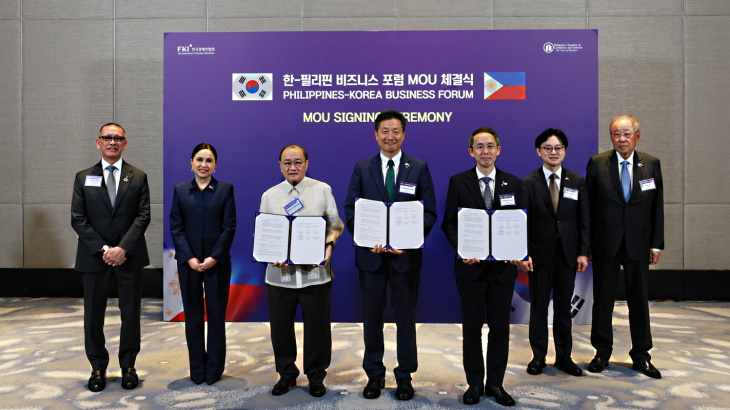
The MoU was signed on Wednesday in Manila during a state visit by South Korea’s President Lee Jae Myung to the Philippines. It was signed by Export-Import Bank of Korea (Korea Eximbank) President Hwang Ki-yeon, Korea Hydro & Nuclear Power (KHNP) Acting President Jeon Dae-wook, and Manila Electric Company (Meralco) Chairman Manuel Pangilinan in a ceremony witnessed by Korean Minister of Trade, Industry and Energy Kim Jeong-kwan and Philippine Secretary of Trade and Industry Maria Roque.
The MoU establishes a foundation for strategic cooperation encompassing technology, human resources, feasibility analysis, and financial support for the Philippines’ new nuclear power plant project. Specifically, the two sides will closely collaborate on: joint discussions on the overall adoption of nuclear power technology; strengthening human resources through education and training; cooperating in the early stages of nuclear power plant development, including site selection and improving acceptance; and exploring financial support measures for nuclear power projects.
“In particular, this collaboration is significant in that it serves as an integrated cooperation model that supports the systematic promotion of new nuclear power plant projects in the Philippines by combining Korea Hydro & Nuclear Power’s nuclear power plant construction and operation experience, the Korea Export-Import Bank’s financial support capabilities, and Meralco’s local power business experience,” KHNP said.
Under the MoU, Korea Eximbank said it will be responsible for reviewing financial support for Meralco’s nuclear power projects, the provision of customised financial packages for Korean companies participates in the projects and the creation of a nuclear power plant ecosystem combining KHNP’s technical expertise with Meralco’s cooperative network.
“This MoU will be an important starting point for expanding Korea Eximbank’s financial know-how into the Philippine nuclear power plant sector,” Hwang said. “We will continue to strengthen our role as a financial engine so that the Philippine nuclear power plant market can establish itself as a future growth engine for our companies.”
“Along with the proven technological prowess of Korean companies, the financial support from Korea Eximbank is a meaningful step forward in strengthening the Philippines’ energy security and driving economic growth,” Pangilinan said.
Philippines’ nuclear plans
In response to the 1973 oil crisis, the Philippines decided to build the two-unit Bataan plant. Construction of Bataan 1 – a 621 MWe Westinghouse pressurised water reactor – began in 1976 and it was completed in 1984 at a cost of USD460 million. However, due to financial issues and safety concerns related to earthquakes, the plant was never loaded with fuel or operated. The plant has since been maintained. There have been several proposals over the years to either start it up or convert it to a gas-fired plant.
Under an MoU on cooperation in the field of energy signed in October 2024 between KHNP and the Philippine Department of Energy, KHNP agreed to conduct a feasibility study to evaluate the possible start up of the mothballed Bataan plant.
In March 2022, then President Rodrigo Duterte signed an executive order that outlined the government’s position for the inclusion of nuclear energy in the Philippines’ energy mix, taking into account economic, political, social and environmental objectives. The country aims to have its first nuclear power plants operational by 2032, with an initial capacity of 1,200 MW, expanding to 2,400 MW by 2035 and reaching 4,800 MW by 2050.
The Philippine Department of Energy released a comprehensive framework in October last year that grants the country’s first nuclear power plant priority dispatch, long-term contracting options, and incentives to accelerate the integration of nuclear energy into the power generation mix. In a circular signed by Energy Secretary Sharon Garin, the US Department of Energy (DOE) formally established the policy foundations for the Philippines’ first commercially developed and operated nuclear power plant, designated as the Pioneer NPP. Under the circular, the department said the Pioneer NPP will be treated as a baseload facility and granted priority dispatch in coordination with the DOE, the Independent Market Operator, and the System Operator, “regardless of the nuclear technology deployed”. It said this “ensures a competitive investment environment for the Pioneer NPP, paving the way for further nuclear developments that will reinforce the country’s long-term energy security”.
Last month, the US Trade and Development Agency announced USD2.7 million in funding for technical assistance to Meralco PowerGen Corp, to evaluate US small modular reactor (SMR) designs and develop an implementation roadmap for the Philippines’ first SMR nuclear power plant. USTDA’s assistance will provide Meralco PowerGen (MGEN) – a subsidiary of Meralco – a comprehensive technical review of advanced US-made SMR reactor designs. The findings will enable MGEN to develop a shortlist of US technology providers for its future procurement needs.