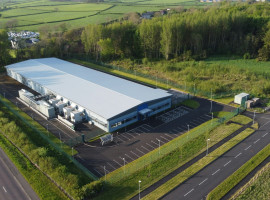
A recent study has found that golf courses across the world take up more land than solar or wind energy plants. The research paper titled, “Countries across the world use more land for golf courses than wind or solar energy,” has reported that the 10 countries with the largest number of golf courses could install up to 842 GW of utility-scale solar or 659 GW of wind capacity on the land they dedicate to the sport. According to the study, the land taken up by golf courses in the 10 countries could install between 281 GW and 842 GW of utility-scale solar on 25% to 75% of the golf courses’ land area. The 75% figure exceeds the 646 GW of cumulative solar capacity currently installed in these 10 countries.
The researchers used the OpenStreetMap database to locate 38,400 golf courses in the world, with 80% located in only 10 countries. The United States tops the list with more than 16,000 golf courses, followed by the United Kingdom (~3,100) and Japan (~2,700). Canada, Australia, Germany, South Korea, France, China and Sweden round out the top 10 countries. According to Jann Weinand of German research institute Forschungszentrum Jülich, the study is not advocating for the direct conversion of golf courses, but rather aims to highlight the vast potential for renewable energy in similarly large and underutilized areas.
‘;
document.write(write_html);
}
“In light of the ongoing debates about land use for renewables, it is crucial to consider how we allocate land overall – especially when significant space is dedicated to activities that benefit only a limited segment of the population,” added Weinand.
Heavy land use has been a frequent talking point by clean energy bears. Fossil fuels are–by far– more energy dense than other energy sources. At 53.1 MJ/kg, natural gas boasts the highest energy density of any fossil fuel, followed by gasoline at 45.8MJ/kg and coal at 30.2MJ/kg.
In comparison, lithium-ion batteries–one of the most effective ways to store renewable energy–can only afford an energy density of 0.504MJ/kg.
By Alex Kimani for Oilprice.com
More Top Reads From Oilprice.com
- Where Will China’s Clean Energy Boom Peak?
- Natural Gas Prices Surge As Arctic Blast Fuels Demand
- Oil Traders Shrink Exposure as Bullishness Wanes