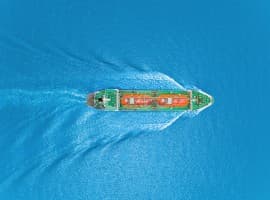
A supertanker headed to pick up crude from Iraq is making a second attempt on Wednesday to pass through the Strait of Hormuz into the Gulf in what could be the first tanker to make it west into the Persian Gulf since the U.S. on Monday initiated a blockade in the Gulf of Oman outside the chokepoint.
The Agios Fanourios I, a very large crude carrier flying the flag of Malta and not blacklisted by any jurisdiction, is broadcasting its position in the Persian Gulf and signals it is headed for Basrah in Iraq, according to vessel-tracking data on MarineTraffic.
The supertanker is set to pick up a crude cargo, which is planned to be delivered to a refinery in Vietnam.
On Wednesday morning local time, the Agios Fanourios I was making its way through the Strait of Hormuz along a Tehran-approved route between the islands of Qeshm and Larak, according to ship-tracking data cited by Bloomberg.
The supertanker first attempted to move into the Gulf on Sunday, but the journey was cut short after the 21-hour-long U.S.-Iran talks collapsed without any progress. On Sunday, the Agios Fanourios I made a U-turn before the Strait of Hormuz.
This is now the second attempt of the tanker to pass the chokepoint.
The U.S. blockade is targeting to choke off Iranian oil exports and the movements of Iran-linked vessels in the area. However, shippers and tanker owners are wary of transits in the area as they are not really certain what the system and the rules of engagement are.
Late on Tuesday, the U.S. Central Command claimed that it had “completely halted economic trade going into and out of Iran by sea”, adding that no vessels had made it past the blockade and six ships had complied with orders to turn back toward Iranian ports.
While the U.S. blocks Iranian shipments out of the Gulf, “Iranian oil flows continue through indirect distribution networks, with significant volumes accumulating offshore rather than transiting directly through Hormuz,” maritime intelligence firm Windward said on Tuesday.
As of April 13, the day on which the U.S. blockade began, at least 11 tankers carrying about 20 million barrels of Iranian oil were positioned offshore Malaysia within a ship-to-ship transfer hub.
“These vessels are likely awaiting counterpart vessels for offloading or preparing for onward movement,” Windward said.
By Tsvetana Paraskova for Oilprice.com
More Top Reads From Oilprice.com
- U.S. Blockade of Hormuz Holds Firm Under Pressure
- Oil Traders Bet on Diplomacy Even as Physical Supply Tightens
- EU Considers Lower Energy Taxes as Hormuz Crisis Drives Costs Higher