By
13 min ago 3 min read
UK-based green gas campaign group the Green Gas Taskforce has urged the Government to back domestic biogas production, warning that the opportunity could be lost without urgent action.
The group cites the lack of a new support scheme to sustain green gas production once the existing scheme closes in the coming years, with the current scheme already oversubscribed. Projects capable of heating a further 300,000 homes are awaiting a decision from the Government.
The group has launched a campaign urging the Government to give the industry certainty at the Budget.
According to the Green Gas Taskforce (GGT), a government consultation on the future of UK green gas has been delayed by almost two years, leaving producers with no clear plan beyond 2028.
Without urgent action, the group warns that investment could stall or move abroad.
With international energy markets becoming increasingly volatile, campaigners say the UK should boost domestic energy security by making better use of agricultural waste.
“We cannot keep wasting a resource that is already ours whilst importing the energy we rely on,” said Charles McAllister, Director of the GGT.
The group claims that 97% of farm waste that could be converted into clean energy remains unused. It also states that £0.85 ($1.12) of every £1 ($1.33) invested in green gas stays within the UK economy. By comparison, for every £1 invested in wind power, only $0.45 ($0.60) stays in the UK, while the figure for solar is £0.10 ($0.13), according to the taskforce.
Scaling up production could also support employment. The industry could provide up to 57,000 jobs by 2050, up from around 5,000 today, according to the group. Nine in 10 of those jobs would be outside London and the South East, with the taskforce estimating that the sector could support 90 jobs in every parliamentary constituency.
“Scaling up Great Britain’s biomethane to its full potential would boost domestic energy security, make us less reliant on other countries for our energy needs and boost local economies across the country,” added McAllister.
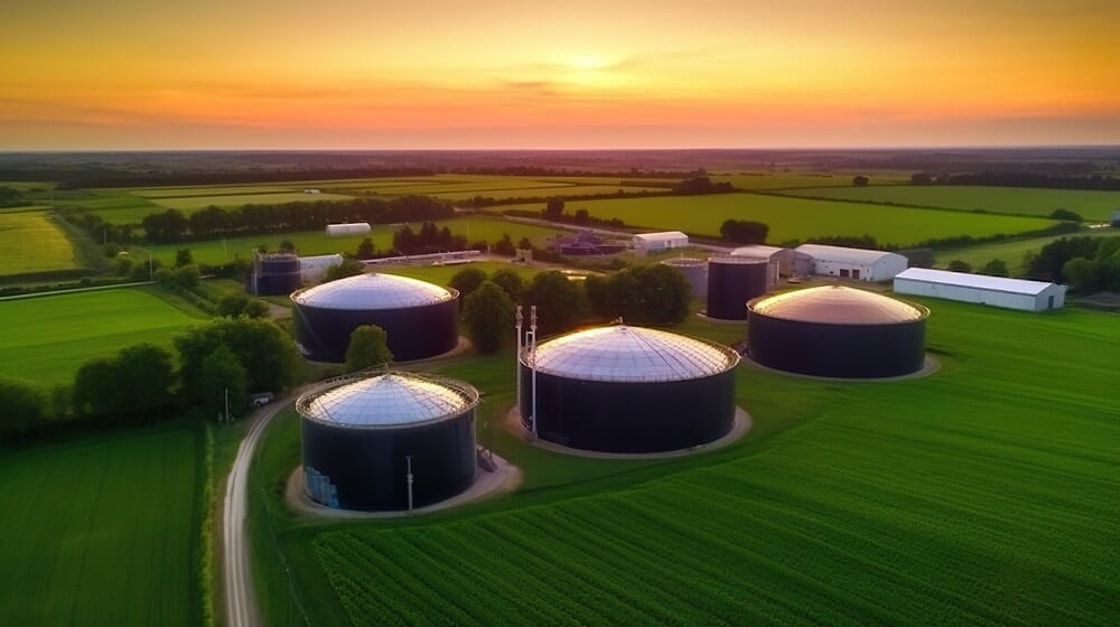
There are currently 140 plants producing biogas across Great Britain, with biomethane, its upgraded form, already injected into the gas network. The taskforce says existing production supplies the equivalent of around one million homes, without requiring changes to customers’ heating appliances.
The UK continues to rely on a combination of domestic production, pipeline imports and liquefied natural gas shipments to meet gas demand, leaving its supply exposed to international market conditions. Expanding domestic biomethane production could help reduce that reliance while making use of agricultural waste.
A separate government briefing found that the UK will need to increase biomethane production around tenfold by 2050 if it is to meet projected demand under future net zero scenarios.
Despite growth in Europe’s overall biomethane sector, the UK market has in comparison, according to a December 2025 study from consulting firm Sia.
Only 23% of available anaerobic digestion (AD) feedstock is currently used, while just 8% of biogas plants are upgraded to biomethane, the study found. This represents one of the lowest upgrading rates in Europe.
In comparison, about 80% of biogas produced in Denmark is upgraded to biomethane and injected into the grid.
The findings add to calls from the anaerobic digestion industry for a clearer long-term policy framework to support investment in new biomethane capacity.