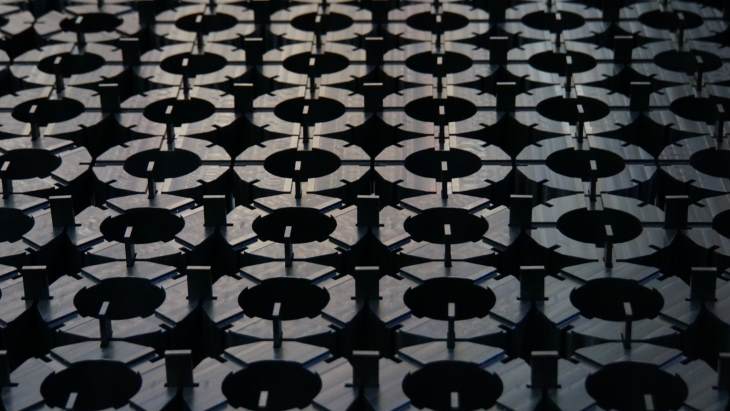
Graphite has been used in nuclear reactor cores as a moderator, slowing down the neutrons released from nuclear fission so that the nuclear chain reaction can be maintained. Most of the power reactors currently in commercial operation – with the exception of the UK’s advanced gas-cooled reactor (AGR) fleet and the Soviet-designed graphite moderated, water cooled RBMK – use light or heavy water as the moderator, but advanced reactor designs, including high-temperature gas-cooled reactors and molten salt reactors, use graphite moderators.
The award brings together world-leading expertise led by the University of Manchester in collaboration with the Universities of Oxford, Plymouth, and Loughborough.
The five-year ENLIGHT (Enabling a Lifecycle Approach to Graphite for Advanced Modular Reactors) programme will develop critical technologies to support the deployment of next-generation nuclear energy technology and will address two of the UK’s most pressing nuclear challenges – securing a sustainable, sovereign supply of nuclear graphite and finding solutions to manage the country’s growing volume of irradiated graphite waste.
The project is supported with a GBP8.2 million (USD11 million) grant from UK Research and Innovation’s Engineering and Physical Sciences Research Council (EPSRC), higher education institutions, and about GBP5 million of contributions from industry partners.
“The programme of research, collaboration, and skills development aims to secure the UK’s position at the forefront of nuclear innovation and a global leader in advanced reactor technology and clean energy innovation,” the partners said.
Graphite accounts for around one-third of reactor build costs, yet despite its importance, the UK currently relies entirely on imports to meet demand. With the existing AGR fleet approaching decommissioning by 2028, and more than 100,000 tonnes of irradiated graphite already in storage, ENLIGHT will pioneer new approaches to both recycling legacy material and producing new, sustainable high-performance graphite suitable for future Advanced Modular Reactors (AMRs).
The ENLIGHT programme will focus on three areas of work: developing processes for decontaminating, recycling and reusing irradiated graphite from AMR deployment; designing new graphite materials engineered to withstand extreme conditions in AMR environments; and understanding how these new materials behave in novel AMR conditions to improve its lifespan.
“These advances could save the UK up to GBP2 billion in future waste management costs and offers a pathway to strengthen the UK’s unique position as a global hub for graphite research and innovation,” the programme partners said.
ENLIGHT will also focus on skills development to expand the national graphite research community and train the next generation of graphite scientists and engineers.
“Nuclear graphite plays a vital role in the safety and efficiency of advanced reactors, yet the UK currently relies on overseas suppliers for this material,” said Principal Investigator Abbie Jones, Chair in Nuclear Graphite at The University of Manchester. “ENLIGHT will lay the foundation to re-establish UK-based graphite supply chain while developing sustainable solutions to recycle and reuse irradiated graphite – transforming a growing waste stream into a valuable resource. This programme will reduce waste, strengthen energy security, and support the country’s net-zero ambitions.”