Friday, 7 March 2025
_34320.jpg)
Tritium recovery and re-use will play a fundamental role in the supply and generation of the fuel in future fusion power plants and will be crucial in making the technology increasingly efficient.
The UKAEA-Eni H3AT Tritium Loop Facility, located at Culham Campus in Oxfordshire, England, will be complete in 2028. It is designed to serve as a world-class facility providing industry and academia with the opportunity to study how to process, store and recycle tritium.
UKAEA and Eni will collaborate to develop advanced technological solutions in fusion energy and related technologies, including skills transfer initiatives. Eni will contribute to the H3AT project with its expertise in managing and developing large-scale projects, helping to de-risk its roadmap. The partnership combines UKAEA’s extensive expertise in fusion research and development with Eni’s established industrial-scale capabilities in plant engineering, commissioning, and operations.
“We are delighted to be working with Eni who have shown great commitment to fusion,” said UKAEA CEO Ian Chapman. “We believe that fusion energy can contribute to a net-zero future, including going beyond the decarbonisation of electricity. The H3AT demonstration plant will set a new benchmark as the largest and most advanced tritium fuel cycle facility in the world, paving the way for innovative offerings in fusion fuel and demonstrating the UK’s leadership in this crucial area of research and development.”
Eni CEO Claudio Descalzi added: “Fusion energy is meant to revolutionise the global energy transition path, accelerating the decarbonisation of our economic and industrial systems, helping to spread access to energy, and reducing energy dependency ties within a more equitable transition framework. Eni is strongly committed to various areas of research and development of this complex technology, in which it has always firmly believed.
“Today with our UK partners we are laying the foundations for further progress towards the goal of fusion which – if we consider its enormous scope of technological innovation – is increasingly concrete and not so far off in time. To continue this virtuous development, international system-level technological partnerships like this one are indispensable.”
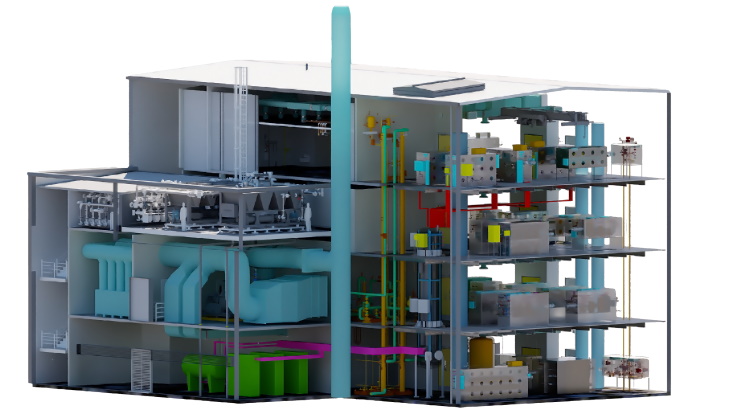
A cutaway of the H3AT Tritium Loop Facility Plant and Building (Image: UKAEA)
The H3AT facilities will comprise: advanced tritium infrastructure, to feed, recover, store and recycle tritium; a flexible suite of enclosures designed to enable a wide variety of experimental work, including pure tritium science, process development, component testing and waste detritiation; computational simulations and model validation; training facilities; and materials detritiation processes and facilities.
H3AT will include a prototype-scale process plant and experimental platform, which is a scaled version of the design for the International Thermonuclear Experimental Reactor.
In May last year, UKAEA appointed Canadian engineering firm AtkinsRéalis to deliver the detailed design of an isotope separation system to strengthen research into sustainable fusion delivery. The Isotope Separation System will form part of the H3AT facility.
The UKAEA carries out fusion energy research on behalf of the UK government, overseeing the country’s fusion programme, including the MAST Upgrade (Mega Amp Spherical Tokamak) experiment as well as hosting the recently closed Joint European Torus (JET) at Culham, which operated for scientists from around Europe. It is also developing its own fusion power plant design with plans to build a prototype known as STEP (Spherical Tokamak for Energy Production) at West Burton in Nottinghamshire, which is due to begin operating by 2040.
In November 2022, the UK’s First Light Fusion announced plans to build a 60 MW pilot power plant based on its unique projectile fusion technology to prove the integrated engineering for electricity generation and the production of tritium. It partnered with Canadian Nuclear Laboratories to design a system for extracting tritium from the reactor. The proposed pilot plant was expected to cost about USD570 million to develop and would produce about 2 kilograms of excess tritium per year.
However, earlier this month, First Light Fusion announced a change in strategy. The Oxfordshire-based company has dropped plans to develop a fusion power plant and will instead focus on commercial partnerships with other fusion companies who want to use its amplifier technology, as well as with non-fusion applications.