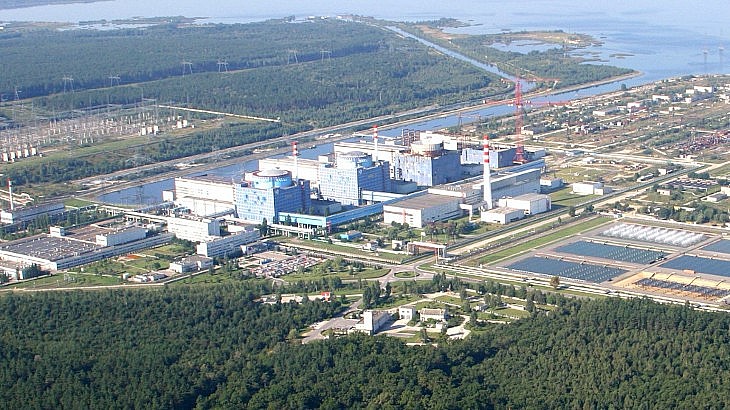
Ukraine and Poland discuss Khmelnitsky expansion plans

The ministry said that Tuesday’s talks, which took place virtually, were within the framework of the United Nations’ , which aims to ensure there is consultation when one country’s plans might have an environmental impact beyond its borders.

Deputy Minister of Economy, Environment and Agriculture of Ukraine Vitaliy Kindrativ said at the start oif the meeting: “We are committed to an open dialogue, are ready to answer all questions from the Polish side, and look forward to constructive interaction.”

The Ukrainian ministry said that during the meeting it “provided the necessary materials and clarifications to the Polish side’s questions, as a result of which the parties agreed to consider the expert consultations completed”.

And Kindrativ said they were open to further dialogue and “committed to constructive cooperation with Polish partners to ensure transparency, safety, and compliance with international environmental standards”.

In April 2024 Ukraine officially notified Austria, Moldova, Poland, Romania, Slovakia, and Hungary about the project. The ministry says that all but Hungary have said they plan to participate in consultations.

Ukraine has 15 reactors, capable of generating half its electricity, at four existing nuclear power plants, including the six-unit Zaporizhzhia plant which has been under Russian military control since early March 2022.

The country has plans for at least nine Westinghouse AP1000 units, including the two new ones planned at Khmelnitsky.

Khmelnitsky’s first reactor was connected to the grid in 1987, but work on three other reactors was halted in 1990, at a time when unit 3 was 75% complete. Work on the second reactor restarted and it was connected to the grid in 2004. There is an on-going goal to complete units 3 and 4 – the two AP1000s would become the fifth and six units at Khmelnitsky, which is located about 200 miles west of Kiev and about 140 miles from the border with Poland.

   

  • Related Posts

    India begins public consultation on SHANTI Bill rules

    The SHANTI Bill – to give it its full name, the Sustainable Harnessing and Advancement of Nuclear Energy for Transforming India (SHANTI) Bill, 2025 – completed the legislative process in…

    Blue Energy, GE Vernova take gas-plus-nuclear collaboration to next stage

    In May, Blue Energy – a vertically integrated deployment platform for financeable, turnkey nuclear power plants compatible with leading reactor technology – announced it was joining up with GE Vernova…

    Have You Seen?

    UCLR completes first hot fire of cryogenic LOX engine

    • August 18, 2026
    UCLR completes first hot fire of cryogenic LOX engine

    Analysis: The key role of LNG in the UK North Sea debate

    • August 18, 2026
    Analysis: The key role of LNG in the UK North Sea debate

    Linde and Monash University Malaysia partner on industrial decarbonisation

    • August 18, 2026
    Linde and Monash University Malaysia partner on industrial decarbonisation

    UK CO2 supply resilience consultation closes this week

    • August 18, 2026
    UK CO2 supply resilience consultation closes this week

    Libya Power Crisis Explodes as Grid Fails Again

    • August 18, 2026
    Libya Power Crisis Explodes as Grid Fails Again

    Chevron Strikes Oil and Gas Offshore Angola in Major Discovery

    • August 18, 2026
    Chevron Strikes Oil and Gas Offshore Angola in Major Discovery

    Russia Receives First Gasoline Cargo From India as Fuel Shortages Spread

    • August 18, 2026
    Russia Receives First Gasoline Cargo From India as Fuel Shortages Spread

    ExxonMobil awards $1.1bn in contracts for Mozambique LNG project

    • August 18, 2026
    ExxonMobil awards $1.1bn in contracts for Mozambique LNG project

    What is the near-term feasibility of helium-3 fuel for fusion power?

    • August 18, 2026
    What is the near-term feasibility of helium-3 fuel for fusion power?

    China Added 200,000 Bpd to Crude Reserves in July Despite Hormuz Crisis

    • August 17, 2026
    China Added 200,000 Bpd to Crude Reserves in July Despite Hormuz Crisis