Kazatomprom could easily sell all its uranium output “into the East” – and new types of buyers need to be aware that the uranium market is in a new chapter rather than just another cycle, Kazatomprom Chief Strategy and International Development Officer Dastan Kosherbayev said on the sidelines World Nuclear Symposium 2026.
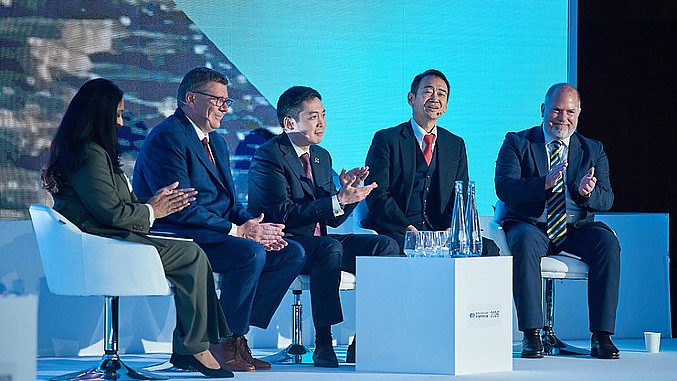
Kazatomprom has a diversified sales portfolio, with about half of the company’s annual sales going to what it calls the East and the rest almost evenly split between Europe and the USA. Year-to-year, the appetite from the East continues to grow, and this is backed up by a concrete set of actions, Kosherbayev said during a panel session at the London conference, which had “From Ambition to Action” as its overarching theme. But this is not being matched in the West, he said, adding that Kazakhstan is “eagerly waiting for when one of the countries in the West will actually start delivering on nuclear capacity”.
“We will do business with everyone who’s willing to do business, and as long as it’s fruitful for all the parties involved, we will be committed,” he said.
While there were “excellent” fundamentals in place, Kosherbayev told journalists the national atomic company of Kazakhstan has to extract as much value as possible for its shareholders. “A lot of Eastern buyers see uranium as more of a strategic commodity and are less price-sensitive than Western buyers, with volumes of more concern to them than pricing.
“At Kazatomprom, we find ourselves in a situation where it’s fair to say that we could have sold the entire volume of our production into the East and still there would be more appetite coming from the East,” Kosherbayev said on the sidelines of the two-day symposium.
Cameco is a joint venture partner with Kazatomprom in the Inkai joint venture, in addition to production from its Tier 1 assets in Canada. Cory Kos, the company’s Vice President, Investor Relations and Communications, said buyers were willing to accept premium pricing for reliable production from safe sovereign jurisdictions, but this is not yet at a level to incentivise Cameco to consider moving its Tier 2 assets – including mothballed assets in the USA – back into operation.
At this stage, Kos said, Cameco sees its Tier 2 assets as competitive with “greenfield” projects – although greenfield projects have a higher risk profile. “When there’s a customer in discussions with a greenfield producer to say we will pay X to start that new mine in 2035, or 2036 … we’ll be at the other end of the table to say, well, you could take a risk with that brand new producer who’s never produced a pound … or you can come to us and we could restart these Tier 2 operations, bring those to the table, and we have alternative sources and such.”
Kos also said new types of buyers – such as hyperscalers – were showing an interest in uranium. “We’ve got a few term sheets out to something, nobody’s bought anything yet, but a few of the big names that you would know are poking around.” Energy security, rather than cost, is the driver here, he said, even when companies are not clear on their own energy strategy just yet. Some such companies may target a strategy of actually building and operating a nuclear reactor to meet their electricity needs, others may consider securing electricity power purchase agreements or similar, while some will simply buy from the grid.
“But in each one of those strategies, they’re all looking at it and saying, well, if I do, or a company that’s running a reactor for me, needs uranium in a tight supply situation, maybe I should just buy some today … And looking at the supply demand scenario today, it doesn’t look like that’s too bad of an investment.”