Wednesday, 23 April 2025
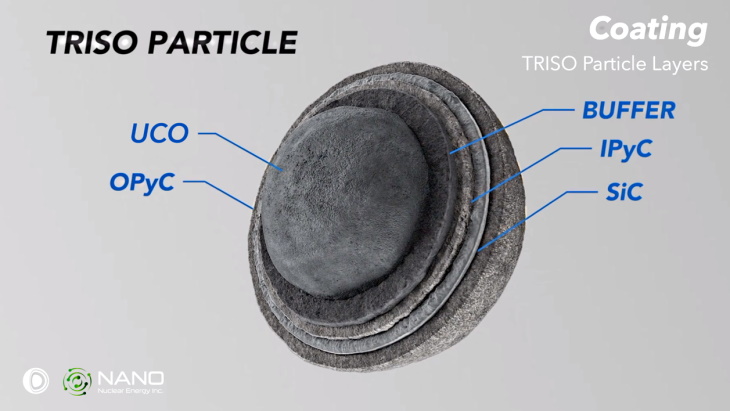
The approved Fuel Qualification Methodology (FQM) defines the regulatory framework and testing approach for the qualification of Fully Ceramic Microencapsulated (FCM) fuel, which incorporates tri-structural isotropic (TRISO) fuel particles embedded in a silicon carbide matrix.
The FQM Topical Report (TR) had previously undergone joint review by the Nuclear Regulatory Commission (NRC) and the Canadian Nuclear Safety Commission, with initial participation from the UK’s Office for Nuclear Regulation as an observer.
NANO Nuclear said it believes that final approval of the FQM TR by the NRC “demonstrates confidence in the methodology’s scientific soundness and regulatory compliance, offering a repeatable pathway for advanced fuel qualification applicable to NANO Nuclear reactors”.
“This is a major victory for advanced nuclear energy and a transformative moment for NANO Nuclear, bringing us closer to turning the promise of KRONOS into a working reality at the University of Illinois Urbana-Champaign (U of I),” said NANO Nuclear CEO James Walker. “With the NRC’s final approval of the FQM Topical Report, we now have the regulatory green light to move forward with the Construction Permit application for the prototype KRONOS. We thank the NRC for their thorough review. This milestone is a critical enabler for our entire reactor programme and affirms the strength of our fuel strategy.”

Rendering of the KRONOS MMR at the University of Illinois (Image: NANO Nuclear)
Illinois Grainger Engineering Associate Professor Caleb Brooks, Head of the Microreactor Demonstration Programme at U of I, added: “Fuel is one of the biggest sources of uncertainty in any advanced nuclear project. This favourable regulatory outcome represents a significant reduction in that uncertainty for our project, and the Safety Evaluation establishes a common language between us and the regulator on how the fuel will be shown, with high assurance, to be safe and effective.”
“Our next steps include finalising fuel fabrication timelines, preparing and submitting the construction permit this year, and completing early-stage site work at U of I, including geotechnical drilling and environmental assessments,” said Florent Heidet, chief technology officer and head of reactor development at NANO Nuclear. “We will keep accelerating until the reactor is operating.”
The KRONOS MMR is a 45 MW thermal, 15 MW electrical high-temperature gas-cooled reactor, using TRISO fuel in prismatic graphite blocks and has a sealed transportable core.
Earlier this month, NANO Nuclear signed a strategic collaboration agreement with U of I to construct the first research KRONOS MMR on the university’s campus. The agreement formally establishes U of I as a partner in the licensing, siting, public engagement, and research operation of the KRONOS MMR, while also identifying the university campus as the permanent site for the reactor as a research and demonstration installation.
The university plans to partially re-power its coal-fired Abbott power station with the KRONOS MMR, providing a zero-carbon demonstration of district heat and power to campus buildings as part of its green campus initiative.