(Reuters) – Oil prices have been a consistent disinflationary force for the U.S. and global economies since mid-2024. That may be about to change.
Fueled by signs of a solid upturn in economic activity at the start of the year and bubbling U.S.-Iran tensions that could spark military conflict, Brent and West Texas Intermediate crude oil futures are the highest in nearly seven months.
Get the Latest US Focused Energy News Delivered to You! It’s FREE:
WTI rose above $67 a barrel on Friday and Brent topped $72, lifting their year-to-date gains to around 15% and nearly 20%, respectively.
More importantly, from an inflation-calculation perspective, oil’s rise means the year-on-year increase is dwindling rapidly, to the point that Brent is now only 2% cheaper than it was a year ago. In early January, it was down almost 30% on the year.
In other words, the so-called “base effects” from oil are close to flipping to inflationary from deflationary. Oil’s base effects have been mostly negative since August 2024, exerting downward pressure on annual inflation rates.
If that changes, it may be harder for the Federal Reserve to justify interest rate cuts. The Fed targets a “core” annual inflation rate, but more expensive oil raises the cost of producing goods and providing services, some of which is borne by the consumer.
IS INFLATION GOING ‘THE WRONG WAY’?
While oil’s role as a driving force of U.S. economic activity and inflation has been diluted over the decades, as industry and manufacturing have declined, crude prices still matter.
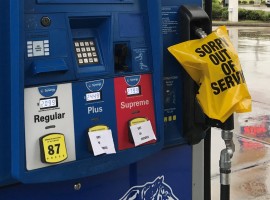
Transportation, including the cost of motor fuel, makes up around 16% of the total monthly consumer price index basket of goods, higher than any other category except shelter.
Consequently, a sustained rise in oil prices can still exert meaningful upward pressure on inflation. A Fed paper in 2023 found that the second-round effects of a permanent 10% increase in oil prices lifts the headline CPI across non-U.S. advanced economies by almost 0.4%.
Gregory Daco, chief economist at EY Parthenon, estimates that a sustained $10 rise in oil boosts annual U.S. inflation by up to 0.2 percentage point.
That doesn’t sound a lot. But oil is already up $10 this year, and U.S. inflation is already around 3% by the Fed’s preferred measure and creeping higher. Could a small amount of unforeseen oil-driven inflation move the Fed’s interest rate dial?
Outgoing Atlanta Fed President Raphael Bostic told a Birmingham Business Journal event on Friday that rate hikes might be needed if inflation threatens to “run away” from the Fed’s 2% target, to ensure the Fed doesn’t lose credibility.
“If it’s going the wrong way, our policy has to respond to that. If it starts to move in the opposite direction again… that would be super concerning, and you would have to have hikes on the table,” said Bostic, who retires at the end of this month.
SHORT-TERM OIL OUTLOOK BULLISH
To be sure, we are nowhere near a full-blown oil shock like those of the 1970s, and few are expecting to see one.
Oil faces a fundamental oversupply issue that should, in theory, limit the upside for prices. With global oil production currently around 106 million barrels per day (bpd), analysts at JPMorgan estimate that production cuts of 2 million bpd would be needed just to avert “excessive” oversupply next year. This suggests that some supply disruption from any U.S.-Iran conflict might be tolerable or be offset by shifts among other producers.
But traders are twitchy nonetheless.
A barrel of crude is up around $10 since early January when Washington started to ramp up its anti-Tehran rhetoric. Full-scale conflict in Iran, though a low-probability scenario, would raise that premium significantly given that roughly 20% of global production goes through the Strait of Hormuz, a narrow shipping lane between Iran and Oman.
Even if that premium were to rise, it does not mean inflation would automatically rise, of course, as there are countervailing price pressures, not least the potential relief from Friday’s U.S. Supreme Court ruling against President Donald Trump’s broad-based tariffs.
Meanwhile, inflation signals from the rest of the global commodities complex are less clear. Some commodities, like corn and wheat, are cheaper than they were a year ago, while others, like copper and other metals, are considerably more expensive.
But with inflation above the Fed’s target for five years running, even the potential for oil to shift from a disinflationary drag to an inflationary booster will give policymakers one more reason to closely monitor the news out of the Gulf.
(The opinions expressed here are those of the author, a columnist for Reuters)
By Jamie McGeever; Editing by Marguerita Choy
Share This:
More News Articles