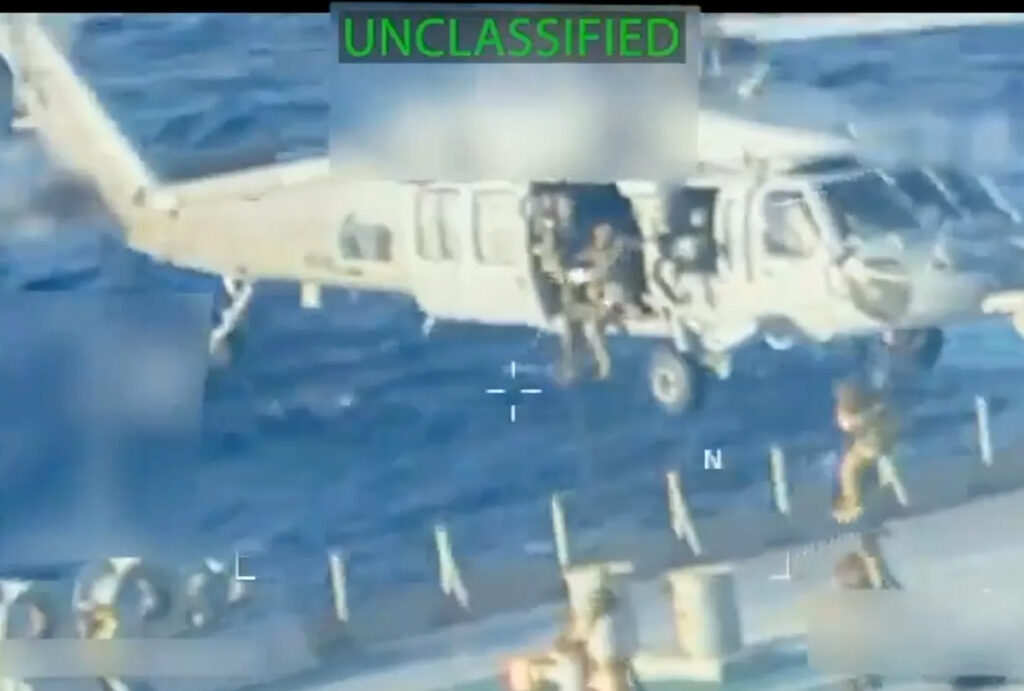
US forces intercept and seize a sanctioned oil tanker off the coast of Venezuela, in a video released by the US Department of Justice on Dec. 10. Source: US Department of Justice
On Dec. 10, US forces intercepted and seized an oil tanker off the coast of Venezuela that Attorney General Pam Bondi said is under US sanctions “due to its involvement in an illicit oil shipping network supporting foreign terrorist organizations.”
Get the Latest US Focused Energy News Delivered to You! It’s FREE:
The seizure represented a sharp escalation in tensions between the countries. The US has positioned warships — including the world’s largest aircraft carrier — troops and warplanes in the Caribbean Sea as part of a military deployment that President Donald Trump says is intended to counter narco-traffickers from Venezuela.
The US has already conducted a series of air attacks on boats in the Caribbean and eastern Pacific Ocean that the Trump administration says were operated by drug cartels, and the president has suggested the Pentagon will escalate the campaign to include strikes on land.
The campaign is part of a broader effort to pressure Venezuelan President Nicolás Maduro to step down. Maduro, along with other regional leaders, has said the US’s actions in the region signal plans to seize Venezuela’s oil reserves. Venezuela called the seizure of the tanker “an act of piracy” in a statement. “The true reasons for the aggression against Venezuela have finally been revealed,” the statement read. “It was always about our natural resources, our oil.” Though Venezuela’s oil industry is in shambles thanks to decades of underinvestment and mismanagement, the country’s oil deposits are still the world’s largest.
Read more:
US officials have not indicated they intend to strike or seize the nation’s oil fields. But regional fears have not been allayed: Venezuela’s oil has long been at the crux of the nation’s relationship to Washington. For much of the past century, US companies dominated Venezuelan oil production before then-President Hugo Chávez nationalized the industry. In recent years, Venezuelan leaders have accused the US government of using sanctions and political pressure to meddle in the country’s energy industry.
Here’s what’s important to know about Venezuela’s crude sector as the US operation plays out.
Is the US likely to attack or seize Venezuelan oil assets?
There is no indication from US officials that oil or gas facilities are targets for strikes. The current military campaign in the Caribbean aims to “disrupt narcotics trafficking and degrade and dismantle Transnational Criminal Organizations,” Defense Secretary Pete Hegseth said on Nov. 11.
Two criminal groups of Venezuelan origin are the primary targets of this operation: the Cartel de los Soles and Tren de Aragua, both designated as terrorist groups. Drug-related assets, including illegal airstrips, laboratories and warehouses allegedly managed by the Cartel de los Soles, are likely to be the next target of US attacks, according to a Washington Post report.
The tanker seized by US forces does not belong to Venezuela’s state oil company, Petróleos de Venezuela SA (PDVSA). The vessel purportedly sails under the Guyana flag, but the country’s Maritime Administration has denied any connection with the tanker. The oil carrier was sanctioned by the US in 2022 for supporting Iranian oil exports. The US had concluded the vessel was bound for Cuba, according to people with knowledge of the matter. A senior Trump administration official said the ship was last docked in Venezuela.
What condition is Venezuela’s oil industry in today?
Crude production in Venezuela has plunged more than 70% since its peak in the late 1990s, when it pumped over 3.2 million barrels a day. Venezuela is now only in 21st place among world producers; its production is poised to be overtaken in the coming years by neighboring rising star Guyana, as well as Argentina, which has historically been a minor producer.
Despite the sector’s state, oil exports are Venezuela’s main source of revenue — though Maduro has focused on diversifying its economy in the last few years. At least 95% of the country’s overseas revenue comes from oil sales.
What caused Venezuela’s oil industry to deteriorate so much?
Venezuela’s oil collapse traces back to the early 2000s, when Chávez’s socialist revolution brought the industry under tighter state control, driving out foreign investment and entrenching corruption and mismanagement. Major western companies, including ConocoPhillips and ExxonMobil, were expropriated after a legal overhaul made PDVSA a majority shareholder in their ventures. Others, including TotalEnergies, left the country voluntarily.
Chávez’s reforms included the dismantling of PDVSA’s meritocracy system and over-staffing the company with party loyalists. A string of accidents plaguing pipelines and oil facilities ensued, including a 2012 explosion at the Cardon refinery complex, one of the largest in the world, causing production to crater and forcing the OPEC nation to import fuel for its needs. Though crude oil prices spiked to more than $100 in the mid 2000s, the industry was further rocked by money laundering cases and international indictments of officials.
There is also the role of US pressure. Over 100 years of US involvement in the country’s oil industry made Venezuela one of Washington’s strongest regional allies. But the US imposed financial sanctions on PDVSA in 2017 and operational sanctions in 2019. The sanctions bar most oil trade and financing with PDVSA while permitting a few licensed exceptions. The restrictions have further deteriorated PDSVA’s facilities, which are highly dependent on US technology the company is now banned from importing.
Are there any foreign oil companies still operating there?
Yes. Houston-based oil major Chevron Corp, which holds a US license permitting limited joint operations with PDVSA to produce oil and ship it to US Gulf Coast refineries, is the last American company still operating after the departures of other majors, including Conoco, Exxon, Total, Shell PLC and Equinor ASA. Spain’s Repsol, Italy’s Eni SpA and France’s Maurel et Prom SA are also present and partner in oil and gas ventures with PDVSA.
US sanctions have discouraged Venezuela’s longtime political allies Russia and China from expanding their partnerships with PDVSA. Russian state oil producer Rosneft transferred its assets in the country to an alternate firm that was not under sanctions — a legal workaround — and China’s state-owned CNPC has kept a minimal presence in the country in recent years.
What nations are the biggest buyers of Venezuelan crude?
China is by far the largest buyer of Venezuelan crude. Venezuela exports oil to the country with so-called ghost ships that disguise the oil’s origins to avoid sanctions. China buys Venezuelan oil via independent refiners, known as teapots, mostly clustered in China’s Shandong province.
In addition, Venezuela’s heavy grades satisfy specific demand for thick “asphalt” crude in the US, where some refineries are tailored to process its oil.
The seizure of the oil tanker may make it much harder for Venezuela to export its crude, as other shippers are now likely to be more reluctant to load the country’s cargoes over fears of detentions by the US.
Will oil prices soar if the US attacks Venezuela?
Probably not. “Isolated attacks to drug trafficking assets such as airstrips or laboratories would have minimal impact on prices,” said Francisco Monaldi, the director of Latin American energy policy at Rice University’s Baker Institute for Public Policy. “The market would quickly absorb it.” This likely absorption is due to Venezuela’s minimal contribution to the world market — it accounts for less than 1% of the world’s output — and the looming worldwide crude glut anticipated by analysts.
The US seizure of the tanker is likely an “isolated incident” with “modest” impacts on oil prices and markets, said David Goldwyn, head of the energy advisory group at the Atlantic Council.
Share This:
More News Articles