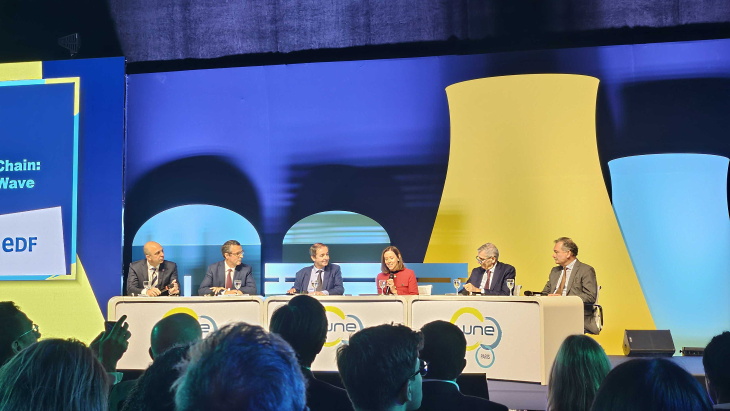
Fontana said EDF has learned from recent nuclear new build projects and reactor operation extensions. He said making an early start on projects helps to ensure there is not a time over-run. “It’s what we do already for the French programme. We are starting production of reactor pressure vessels, steam generators and pumps,” he said. “The projects we have will require a complete new mindset, shifting from a traditional supply chain to a long-term value chain.”
He noted: “Every industry that has achieved true operational excellence – like aviation, rail, automotive – has done so through standardisation, and nuclear must follow the same path, moving from one-off projects to series effect, from prototype to programming.”
Pierre Anjolras, CEO of Vinci, said in order to achieve this the supply chain needs to be more coordinated. He suggested improving coordination requires the creation of “a genuine industry cluster … And I mean not only a selection of companies, maybe 10, 15, or 20 of them, but also a selection of 10, 15, or 20 CEOs who are fully committed, and fully committed to commit their best resources to the project from day one and for the long-term.”
To achieve this cluster, he said three conditions must be met from a contractor’s point of view. Firstly is early involvement of contractors – the involvement of the value chain partner as early as possible in the project, even at design phase. “This is to ensure a good definition of the project to be built, to ensure the proper finalisation of the detailed design, to ensure that there are only minor modification during a design phase.” Secondly, the contract policy needs to be structured so that there is “a clear and rapid decision-making chain at project management, taking its full responsibilities close to the job site, whose sole objective is the performance of the project”. The third condition to be met is continuity. “To be capable, to mobilise the appropriate workforce, we need continuity and visibility to recruit all the workforce, to train them, because this is long-term recruitment. And this continuity will also help us to put in place some innovations, including AI.”
“Nuclear is no longer a national issue, as it was,” said Roberto Adinolfi, president of Italy’s Ansaldo Nucleare. “It is becoming a joint challenge, at least in Europe, if not in the Western world. The concurrent programmes that we can expect in different countries in Europe will also imply an internal competition to make the proper use of the limited resources that we have and this is a temptation to go for national interest. But we have to keep in mind that if we serve only the national interest, we are not addressing the challenges that we are asked to address, that are transnational, really.”
He said that to attract new players in the supply chain – as well as encouraging existing players to invest in new processes and products – “a broad European common market” needs to be created that will provide “a levelised playground accessible for any company in Europe”. Adinolfi added: “Standardisation is the best way for us to create this condition. We have to push it. But standardisation in all nuclear activities, as has already been said, not only in design and not only in licensing, but in construction.”
Mammoet CEO Joost Goderie said that it is “very important that we are involved quite early on in the process of building or in engineering, and that we can also be part of the logistical solution while constructing.” He said the company can add value to projects by bringing its experience from other industries.
“Bringing value in the project is to help the project to be successful at the end,” said Stephane Aubarbier, deputy CEO of Assystem. “In nuclear, as in any other intensive CapEx project, the timeline – I mean the schedule – is the enemy.” He continued, “To be on time, probably two main points need to be addressed. The first one is to have a stabilised and easy to construct design before starting the construction … The second point I’d like to highlight is the fact that during the construction, the logic of the management of the programme is changing. Most of the projects we have, especially in France – it’s the case in Europe, globally speaking – but in France especially, we tend to draw the programme and the projects around the management of the contracts placed on the market, whereas, in fact, the contracts should service the project timeline. When we reach the construction phase, it’s impossible to carry on that way, because the logic of construction is geography. It’s not market. Markets are done by techniques, by systems, not by geography.”
Fontana stated: “We need a more integrated, early work involvement, more cooperative, more standardised approach … So an approach that connects large industrial groups, but also SMEs, research organisations, training institutions, in a shared performance model.” He called for “long-term partnerships built on trust, visibility, and shared objectives … EDF is working to make this shift real, by sharing forecasts, project pipelines, by investing together, industrial tools and skills, by ensuring that our partners benefit from the fleet effect, from design once, build many, and by listening.”
Concluding the session, he said “we must make our project execution more agile, drawing lessons from other industrial sectors, and ensure our nuclear projects are not just EDF projects, but shared ones, driven by all partners and working towards a single objective, delivering value for the project, value for the money, and repeat and repeat in the long term. So building this partnership with the supply chain will make us leaner, faster, more reliable, without ever compromising on safety and quality.”