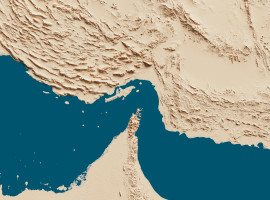
How likely is it that the U.S. would allow Iran to tax, or impose a toll on, ships transiting through the Strait of Hormuz in exchange for a peace deal?
This was the question Rigzone posed to Simon Henderson, the director of the Washington Institute’s Bernstein Program on Gulf and Energy Policy. Responding to the question, Henderson told Rigzone that this scenario wouldn’t be likely “unless the U.S. found itself dealing with a different government in Iran”.
If an Iranian tax/toll on the Strait of Hormuz was allowed, Henderson outlined to Rigzone that this would cause fissures between the U.S. and its Middle East partners, adding that such a scenario would “completely undermine the basis of Washington’s relationships with the Gulf states”.
Asked if these fissures would have any implications for the global oil and gas industry, Henderson said they “absolutely” would, but told Rigzone that, in the short and medium term, “such fissures would boost the oil and gas industry in other parts of the world”.
Rigzone also spoke to Howard Shatz, a senior economist at RAND and a professor of policy analysis at the RAND School of Public Policy. Although Shatz refused to be drawn on the likelihood of the U.S. allowing Iran to impose a toll on ships transiting the strait in exchange for a peace deal, he told Rigzone that, if an Iranian toll was allowed, it could anger Middle East U.S. partners and cause rifts between the parties.
“Relations between the Gulf countries and Iran are at a trough and the Gulf countries will long remember that Iran attacked them,” Shatz said.
“On the other hand, Gulf countries still expect the United States to support them, especially given the quantity of weapons they buy from the United States,” he added.
Shatz went on to tell Rigzone that, “for decades (really since WWII), the United States has been the main guarantor of the security of oil flows from the Middle East”.
“If a security relationship were to break down, the main effect the fissures could have is by raising the level of risk and therefore of insurance payments, leading to slightly higher oil and gas prices,” he added.
“But I think this is a weak chain,” he went on to note.
Shatz told Rigzone that the world needs oil and gas and said the Gulf countries are an important source.
“Their product will continue to be in high demand,” he said.
“And once Iran is getting tolls, it will have incentive to make sure oil and gas flow,” he added.
Rigzone asked the White House if it would allow Iran to tax/toll ships through Hormuz in exchange for a peace deal and, if such a toll was allowed, whether it thinks this would cause fissures between the U.S. and its Middle East partners. Rigzone also asked the White House and the Iranian Ministry of Foreign Affairs for comment on Henderson and Shatz’s statements.
In response, a White House spokesperson directed Rigzone to statements made by U.S. President Donald Trump to the press on Tuesday while visiting the White House ballroom construction site, which were streamed live by the White House YouTube page.
Trump revealed in these statements that he was close to striking Iran again but highlighted that U.S. partners in the Middle East had asked him to wait.
“Primarily Saudi Arabia, Qatar, UAE, Kuwait … Bahrain and some of the others … we’re all working together, it’s like a team, and Israel of course, and Israel’s been a great partner, and so we are negotiating together,” Trump said outside the ballroom construction site.
“I got a call from numerous of these people, they know the people in Iran …I got a call yesterday [Monday] – ‘sir, could you wait, we think we’re close to a deal’,” he added.
“They said ‘sir, could you give us a couple of more days, because we think they’re being reasonable,” he continued.
Trump went on to state that “we can’t let them [Iran] have a nuclear weapon”.
At the time of writing, the Iranian Ministry of Foreign Affairs has not responded to Rigzone. Rigzone has also contacted the Iranian Ministry of Foreign Affairs for comment on Trump’s statements outside the ballroom construction site. At the time of writing, the ministry has not responded to this request either.
In a statement posted on his Truth Social page late Monday, U.S. President Donald Trump revealed that “serious negotiations are now taking place” with Iran.
“I have been asked by the Emir of Qatar, Tamim bin Hamad Al Thani, the Crown Prince of Saudi Arabia, Mohammed bin Salman Al Saud, and the President of the United Arab Emirates, Mohamed bin Zayed Al Nahyan, to hold off on our planned Military attack of the Islamic Republic of Iran, which was scheduled for tomorrow [Tuesday], in that serious negotiations are now taking place, and that, in their opinion, as Great Leaders and Allies, a Deal will be made, which will be very acceptable to the United States of America, as well as all Countries in the Middle East, and beyond,” Trump said in the statement.
“Based on my respect for the above mentioned Leaders, I have instructed Secretary of War, Pete Hegseth, The Chairman of The Joint Chiefs of Staff, General Daniel Caine, and The United States Military, that we will NOT be doing the scheduled attack of Iran tomorrow, but have further instructed them to be prepared to go forward with a full, large scale assault of Iran, on a moment’s notice, in the event that an acceptable Deal is not reached,” he added.
In a statement posted on his X page on Monday, which was translated from Persian, Iran President Masoud Pezeshkian said, “dialogue does not mean surrender”.
“The Islamic Republic of Iran enters into dialogue with dignity, authority, and the preservation of the nation’s rights, and under no circumstances will it retreat from the legal rights of the people and the country,” he added.
“We will serve the people with logic and with all our might, to the end, and safeguard the interests and honor of Iran,” he continued.
To contact the author, email