India’s rapidly expanding solar industry faces a critical operational challenge: high soiling rates in arid and semi-arid regions. While PV modules require frequent cleaning (at least twice a month), the water used for this purpose is often hard, sourced from Borewells with TDS levels exceeding 550 ppm. This hard water, rich in minerals like calcium and magnesium, leaves behind white scale deposits on module surfaces.
The Financial and Operational Toll of Hard Water
The use of poor-quality water has a profound impact on the economic viability and long-term health of solar assets:
- Significant Energy Loss: Even a modest 2% reduction in light transmission can lead to an annual revenue drop of 1.5–2%. Over a 25-year project lifespan, these losses can accumulate to a substantial sum.
- Escalated O&M Costs: The struggle to remove mineral deposits necessitates frequent use of expensive chemicals and requires additional labour, significantly increasing operational and maintenance expenses.
- Accelerated Asset Degradation: Mineral deposits can cause abrasion, and the expensive chemical cleaning methodologies used to remove them which can damage the anti-reflective coatings and glass surface of modules. This shortens the lifespan of the assets, leading to higher capital expenditure for replacements.
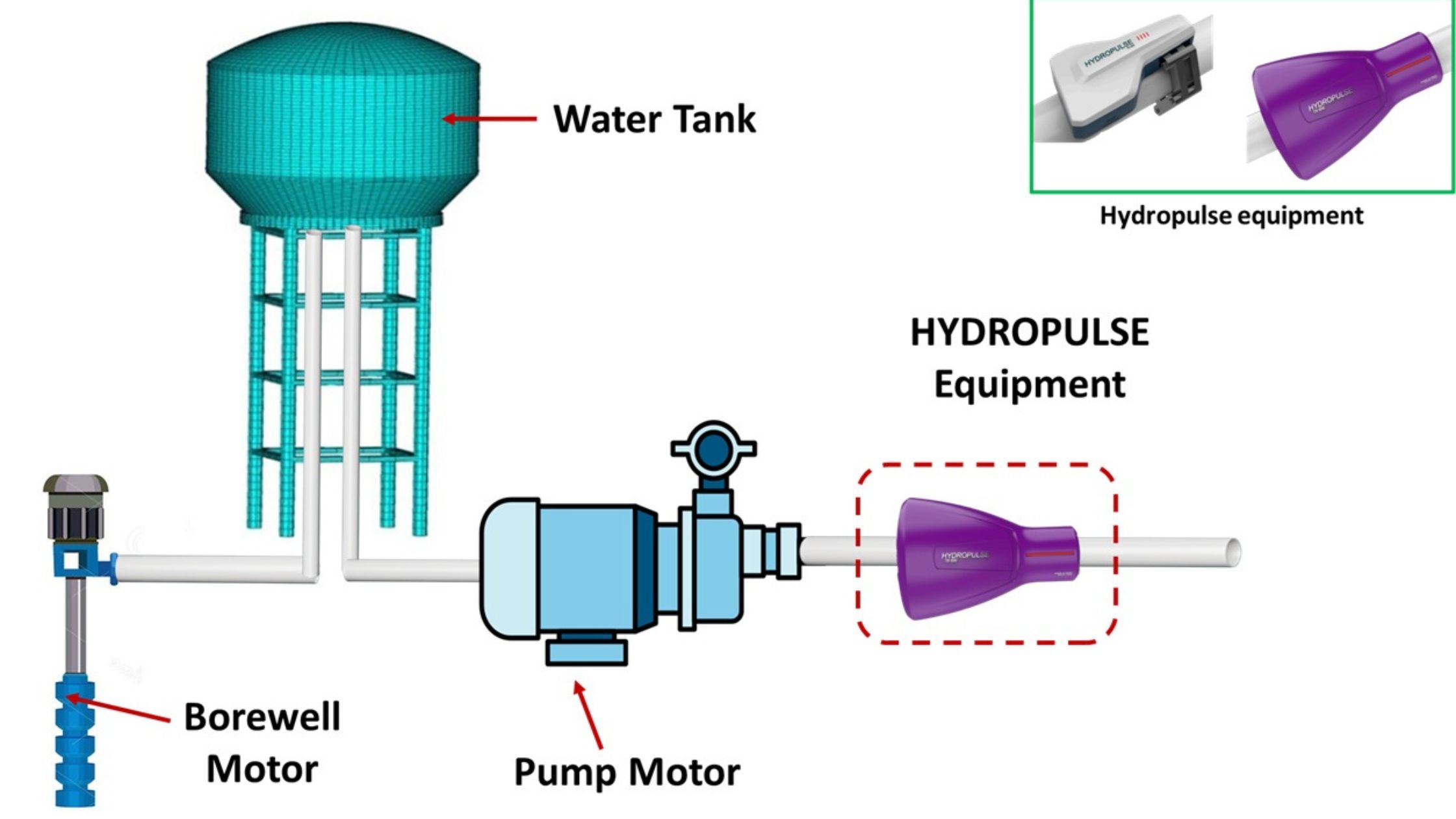
“HYDROPULSE” is a Chemical-free, battery-operated water-conditioning gadget that makes borewell hard water safe for cleaning solar PV modules.
With a lifespan of over 10 years and a 2-year warranty, it requires no consumables and Zero maintenance. Available for pipe sizes from 1 inch to 12 inches, it’s a simple ‘mount-and-forget’ solution all at a drastically lower installation cost.
Seamless Integration Options:
- Mounted on the Cleaning Pipe System:
The HYDROPULSE unit can be directly mounted on the cleaning pipe, typically located at the output of the water tank. This allows the water to be conditioned just before it is used for cleaning, ensuring that every drop that touches the PV modules is free of scale-forming minerals.
- Mounted on the Tractor System Pipe:
For automated or large-scale cleaning operations using tractor-based systems, HYDROPULSE can be easily installed on the tractor’s cleaning pipe. This ensures that even high-volume water distribution benefits from the conditioning process, protecting a larger number of modules efficiently.
This flexible deployment ensures that HYDROPULSE can be adapted to both manual and automated cleaning processes, making it a universal solution for improving water quality across the entire solar industry.
Key Benefits of HYDROPULSE:
- Condition Hard Water: Prevents scale deposits and protects module surfaces.
- 100% Chemical-Free: Environmentally safe.
- Zero Maintenance & Cost-Effective: A low-upkeep solution that delivers long-term savings.
- Scalable: Suitable for solar plants of all sizes.
Conclusion:
By ensuring high-quality cleaning water, HYDROPULSE helps maximize energy output, protect valuable assets, and secure the long-term profitability of solar projects.
Tejas Sole, COO – Solar & New Energy Business
LeanWay Energy Pvt Ltd. Pune, Maharashtra
tejas@leanwayenergy.com
Subscribe to get the latest posts sent to your email.