Monday, 16 December 2024
_41817.jpg)
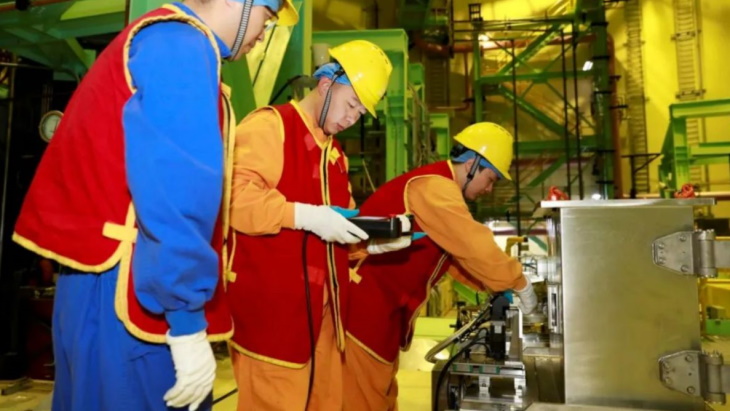
There is no isotope irradiation test function module in the original design architecture of the pressurised heavy water reactor (PHWR), People’s Daily reported. It said this meant that the Qinshan project team needed to create a special device that could seamlessly embed the isotope irradiation test function and is compatible with the existing design of the reactor, as a core irradiation test platform. It noted medical isotopes are mostly short-half-life isotopes, which require the rapid loading and unloading of irradiation test targets during the normal operation of the reactor.
“After repeated adjustments, the project team and the design institute finally designed a prototype of the device concept,” People’s Daily said. The isotope irradiation test platform reportedly has the ability to automatically load and unload isotope irradiation targets online.
“During the debugging and verification process of the device, it underwent thousands of action tests, which fully verified the reliability of the device,” People’s Daily said. “On 3 April 2023, the National Nuclear Safety Administration officially approved Qinshan Nuclear Power to use the irradiation test device to conduct yttrium-90 irradiation tests. On 23 April, the project team continued to work for nearly 120 hours during the overhaul of Qinshan No.3 Plant, successfully completing the device installation, cold commissioning and system identification operations. On 14 December, with the first yttrium-90 target successfully unloaded from the reactor, the hot test of the device was successfully completed.”
The report noted that this marks the official completion of the first commercial reactor isotope research and development platform in China.
 (Image: CNNC)
“The platform has successfully realised the research and development and production of short-half-life medical isotopes for domestic commercial reactors, opening up a new path for the localisation of medical isotopes and the development of radioactive drugs,” it added. “In the future, Qinshan Nuclear Power will continue to deepen the production of reactor-irradiated isotope irradiation, and contribute to the independent and controllable supply of medical isotopes and the expansion of diversified applications of nuclear technology in China.”
China National Nuclear Corporation’s Qinshan comprises seven reactors, making it China’s largest nuclear power plant. Construction of Phase I of the plant – a 300 MWe pressurised water reactor (PWR) which was the first indigenously-designed Chinese nuclear power station to be built – began in 1985, with the unit entering commercial operation in 1994. Qinshan Phase II is home to four operating CNP-600 PWRs, built with a high degree of localisation. Units 1 and 2, comprising the first stage of Phase II, began operating in 2002 and 2004, respectively. Units 3 and 4 entered commercial operation in October 2010 and April 2021. Phase III consists of two 750 MWe pressurised heavy water reactors supplied by Atomic Energy of Canada Ltd and commissioned in 2002 and 2003.
In April this year, CNNC announced that the Qinshan plant has started mass production at one of its PHWRs of carbon-14, which is used in medical and scientific research and in fields including agriculture and chemistry as well as in medicine and biology. Apart from very limited production in experimental reactors, it was previously imported.